QuestionQ1
Analyze requirementsUnder which condition is a Mode Conditioning Patch Cable necessary?
QuestionQ2
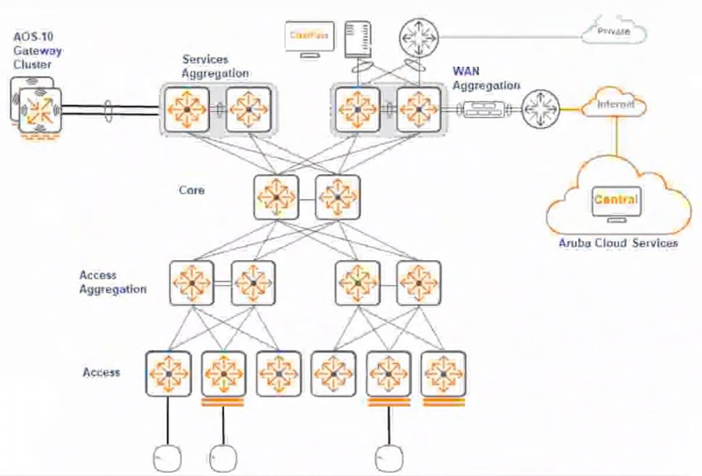
Propose the solutionA large multinational financial institution has engaged you to design a new full-stack wired and wireless network for its new 6-story regional office building. The bottom two floors of the facility will provide retail space for a large banking branch. The upper floors will be carpeted corporate office space, with each floor approximately 100,000 sq ft (9290 sq m). All data centers are offsite and outside this project’s scope. The customer is inadequately served by its existing L2-based network infrastructure and wants to use modern best practices in the new design. The network must be fully resilient and fault-tolerant, with dynamic segmentation at the edge.
The retail space will offer public guest Wi-Fi access. Retail associates will use corporate tablets for customer service, and the retail floors will contain a mix of wired and wireless devices. Corporate users will mainly connect wirelessly, although several wired clients, printers, and hard VoIP phones will also be used.
The customer also plans to renovate the corporate office space to take advantage of “smart office” technology. These enhancements will enable blue-dot wayfinding, presence analytics, and other location-based services.
The client wants redundant RADIUS resources in each of its three geographic regions: AMER, EMEA, and APAC. A large office location in each region has sufficient VMware resources available.
Each region has between 4,481 and 5,692 clients, all of which must perform either 802.1X wired or wireless authentication, as well as 802.1X authentication for one personal Wi-Fi device.
All non-personal devices must also validate health using a local agent.
A total of 500 guests are expected to be connected on average, with a maximum of 700 simultaneous connections using Guest Portal for Internet access.
TACACS authentication will also be configured for 1200 evenly distributed NADs.
How many OnGuard Licenses are required in this scenario?
Community Discussion
QuestionQ3
Propose the solutionXYZ Regional Hospital is an integrated healthcare system comprising hospitals, neighborhood health centers, and small doctor offices. XYZ Regional Hospital has recently merged with 4x neighborhood health centers and 125 doctor branch offices. Its wireless, wired access, and AAA solutions are outdated and must be replaced.
XYZ Regional Hospital wants to future-proof and improve efficiency at all sites by enhancing wired and wireless access and moving to centralized, unified wired/wireless and policy management that delivers uninterrupted availability of all systems.
Locations:
- XYZ Regional Hospital is located in New York City
- Dila Health Center is located in City A
- Mount Health Center is located in City B
- Rock Health Center is located in City C
- Branch clinics are located at different locations across the United States
Requirements:
- Provide, through management software, a single pane of glass to manage wired and wireless LANs and VPNs across campus, branch, and remote environments through a web/cloud architecture that provides near-real-time insight, troubleshooting tools, and Service Level performance reporting.
- Seamless integration across wired, wireless, WAN, SD-Branch, and IoT
- Provide secure wireless access for all Regional Hospital employees and partners, and wireless Internet access for medical citizens when they visit the facilities.
- All access points must support these features and specifications: 802.11 ax (Wi-Fi 6E Certified)
- Security options including WP2/WPA3 and 802.1X with Radius secure authentication
- Identify and authenticate every wireless and wired device
- End-to-end role-based security
- Seamless mobility across the hospital for medical teams, patients, and visitors
- Cut Wi-Fi deployment times from days to hours and enable Zero-Touch deployments across the site
- Establish a resilient, future-ready network infrastructure with the intelligence, scalability, and intuitive toolsets to meet emerging needs
- Fully redundant branch solution with dynamic path selection to the hospital
The hospital IT director is concerned that branch clinics will lack an onsite resource to troubleshoot issues that may arise and wants a solution that enables the hospital IT team to proactively monitor the branch offices.
Requirements:
- Monitor wireless and wired connections
- Provide an end-to-end experience view that identifies points of failure
- Proactively troubleshoot issues that affect application performance
What is the correct solution?
Community Discussion
QuestionQ4
New technologiesWhat distinguishes OM4 cabling from OM5 cabling?
Community Discussion
QuestionQ5
Propose the solutionYou are taking part in a joint technical and business review with a customer that plans to deploy HPE Aruba Networking User Experience Insight (UXI) across multiple sites. The customer has a large campus with several buildings and smaller remote offices, and is assessing UXI as part of its digital-experience monitoring strategy.
During the review, the technical team is concentrating on deployment best practices and technical capabilities, while business stakeholders are concerned about deployment efficiency, cost justification, and ensuring the sensors deliver actionable visibility throughout the environment.
You are asked to provide validated deployment guidance and correct any misconceptions about UXI capabilities and deployment options.
What is a valid recommendation for UXI deployment options?

Community Discussion