QuestionQ368
Layer 3 Technologies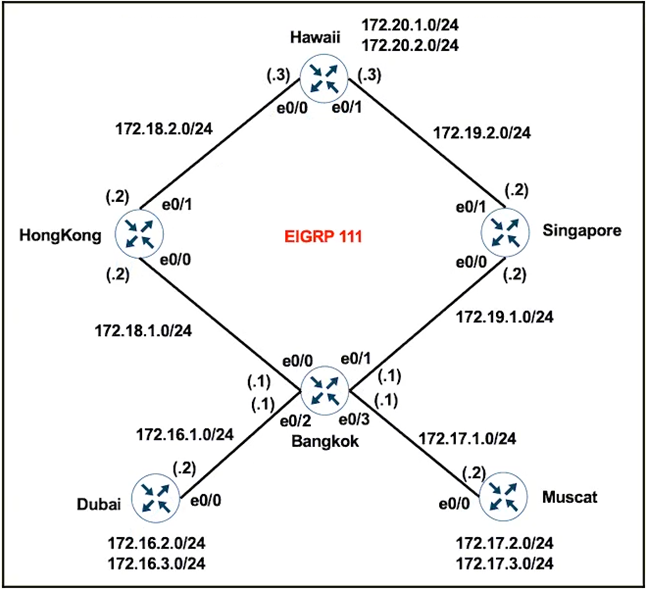
Refer to the exhibit. Bangkok uses ECMP to reach the 172.20.2.0/24 network. The network administrator must configure it so that traffic from the 172.16.2.0/24 network uses the Singapore router as its preferred route. Which configuration set accomplishes this task?
- A Bangkok -access-list 101 permit ip 172.16.2.0 0.0.0.255 172.20.2.0 0.0.0.255!route-map PBR1 permit 10match ip address 101set ip next-hop 172.19.1.2!interface Ethernet0/1ip policy route-map PBR1
- B Dubai -access-list 101 permit ip 172.16.2.0 0.0.0.255 172.20.2.0 0.0.0.255!route-map PBR1 permit 10match ip address 101set ip next-hop 172.19.1.2set ip next-hop peer-address!interface Ethernet0/0ip policy route-map PBR1
- C Bangkok -access-list 101 permit ip 172.16.2.0 0.0.0.255 172.20.2.0 0.0.0.255!route-map PBR1 permit 10match ip address 101set ip next-hop 172.19.1.2!interface Ethernet0/2ip policy route-map PBR1
- D Dubai -access-list 101 permit ip 172.16.2.0 0.0.0.255 172.20.2.0 0.0.0.255!route-map PBR1 permit 10match ip address 101set ip next-hop 172.19.1.2!interface Ethernet0/0ip policy route-map PBR1
Community Discussion