About the Exam

Prepare for the UIAAPV1: UiPath Agentic Automation Professional Exam certification from UiPath with 105 practice questions, community discussion, and detailed explanations.

How to Use This Practice Exam

  1. Browse — Read each question, select your answer, and reveal the explanation.
  2. Exam Mode — Simulate real exam conditions with a timed session and score report.
  3. Learn Mode — Spaced repetition schedules questions you struggle with for long-term retention.

Download the Full Exam PDF

Get every question and answer in a clean, printable PDF built for offline study. Purchase once, keep permanent access, and re-download the latest version anytime.

Last updated November 3, 2026 at 7:41 PM

Question status
Question sort
Questions per page

QuestionQ1

Verified

An insurance company needs to automate end-to-end policy validation by ingesting customer records from its CRM, invoking multiple REST APIs to verify coverage and eligibility against external data sources, and reconciling results for audit compliance. The process must handle authentication challenges, intermittent API outages, and changing response schemas, while providing clear progress and error reporting for business users.

Which workflow design approach is best?

Explanation

A modular workflow can manage API authentication consistently, validate and adapt responses as schemas change, and use retries and graceful error handling for intermittent outages. Progress and error logs support business-user visibility and audit reconciliation. UiPath provides centralized connection management and a Retry Scope activity for retrying operations when errors occur. (docs.uipath.com)

Learn more

Community Discussion

No comments yet. Be the first to start the discussion!

QuestionQ2

Verified

In the illustrated insurance-claim automation, the agent analyzes incoming emails and escalates uncertain cases for confirmation before proceeding.
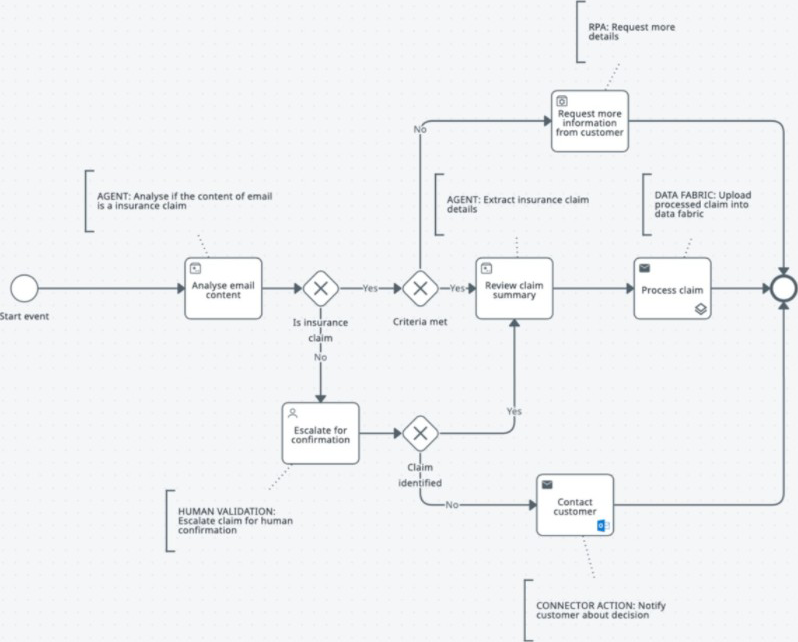
Question Image

When configuring Human-in-the-Loop for this process, which configuration best ensures accurate claim identification while maintaining automation efficiency?

Explanation

Escalating emails that cannot be confidently identified as insurance claims lets a human confirm their classification before processing continues. Confidently identified claims can proceed automatically, reducing unnecessary manual review. Appian recommends human review for low-confidence decisions. (appian.com)

Learn more

Community Discussion

No comments yet. Be the first to start the discussion!

QuestionQ3

Verified

A logistics optimization agent is built to operate within a fleet coordination system and must dynamically adjust delivery schedules based on real-time route conditions. The agent is expected to autonomously execute operational updates while staying aligned with its defined objective and measurable outcomes.

Which implementation best reflects proper tool integration within the agent story framework?

Explanation

Executable route optimization and fleet scheduling tools enable the agent to invoke automations and update delivery plans directly in response to changing conditions. Read-only insights, recommendations, or notifications following manual revisions do not satisfy the requirement for autonomous operational updates. (learn.microsoft.com)

Learn more

Community Discussion

No comments yet. Be the first to start the discussion!

QuestionQ4

Verified

How are activity input methods configured in UiPath agent tools, and what are the main considerations for cascading fields?

Explanation

Activity inputs can use Prompt by default, an Argument defined beforehand, or a fixed Static Value. Cascading fields cannot use Prompt because their values change the structure of other fields, and the tool schema cannot adjust dynamically at runtime. (docs.uipath.com)

Learn more

Community Discussion

No comments yet. Be the first to start the discussion!

QuestionQ5

Verified

Which statement best distinguishes deterministic evaluators from LLM-based (model-graded) evaluators when designing agent evaluations?

Explanation

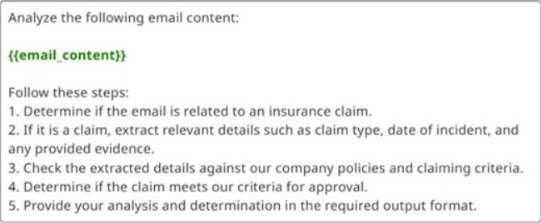
Deterministic evaluators apply predefined rules and produce consistent results for identical inputs without using an LLM. In UiPath, they therefore have no Model selection field and are well suited to strictly defined outputs such as booleans, specific numbers, exact strings, and arrays of primitives. LLM-based evaluators can assess meaning and accommodate reasonable language variation. (docs.uipath.com)

Learn more

Community Discussion

No comments yet. Be the first to start the discussion!
Know a question that should be here? Contribute to this exam
Back home