ConceptsIntroduction to the ADMIntroduction to the ADM TechniquesIntroduction to Applying the ADMIntroduction to Architecture GovernanceArchitecture Content
It includes establishing an Enterprise Architecture Capability.
It provides architectural oversight for the implementation.
Which ADM Phases do these describe?
A1=Phase E, 2=Requirements Management
B1=Preliminary Phase, 2=Phase G
C1=Phase A, 2=Phase B
D1=Phase C, 2=Phase H
You have been asked to outline the steps you would take to increase the resilience of the current architecture.
Based on the TOGAF standard, which of the following is the best answer?
AYou would ensure that the company has in place up-to-date processes for managing change to the current Enterprise Architecture. Based on the scope of the concerns raised you recommend that this be managed at the infrastructure level. Changes should be made to the baseline description of the Technology Architecture. The changes should be approved by the Architecture Board and implemented by change management techniques.
BYou would determine business continuity requirements, and undertake a gap analysis of the current Enterprise Architecture. You would make recommendations for change requirements to address the situation and create a change request. You would manage a meeting of the Architecture Board to assess and approve the change request. Once approved you would produce a new Request for Architecture Work to activate an ADM cycle to carry out a project to define the change.
CYou would request an Architecture Compliance Review with the scope to examine the company's resilience to ransomware attacks. You would identify the departments involved and have them nominate representatives. You would then tailor checklists to address the requirement for increased resilience. You would circulate to the nominated representatives for them to complete. You would then review the completed checklists, identifying and resolving issues. You would then determine and present your recommendations.
DYou would monitor for technology changes from your existing suppliers that could improve resilience. You would prepare and run a disaster recovery planning exercise for a ransomware attack and analyze the performance of the current Enterprise Architecture. Using the findings, you would prepare a gap analysis of the current Enterprise Architecture. You would prepare change requests to address identified gaps. You would add the changes implemented to the Architecture Repository.
Complete the sentence below. In the ADM, documents that are still under development and have not completed any formal review and approval process are _______.
Ain between phases
Binvalid
Ccalled “draft1”
Dknown as “Version 0.1”
QuestionQ6
Introduction to the ADM Techniques
0
Community Discussion
No comments yet. Be the first to start the discussion!
QuestionQ7
Introduction to Applying the ADM
QuestionQ8
Introduction to Applying the ADM
QuestionQ9
Introduction to Applying the ADM
QuestionQ10
Concepts
QuestionQ11
Introduction to Applying the ADM
QuestionQ12
Concepts
QuestionQ13
Concepts
QuestionQ14
Introduction to Applying the ADM
QuestionQ15
Introduction to Applying the ADM
QuestionQ16
Concepts
QuestionQ17
Architecture Content
QuestionQ18
Concepts
QuestionQ19
Introduction to Applying the ADM
QuestionQ20
Introduction to Architecture Governance
QuestionQ21
Introduction to Applying the ADM
QuestionQ22
Introduction to Architecture Governance
QuestionQ23
Concepts
QuestionQ24
Introduction to Applying the ADM
QuestionQ25
Introduction to Applying the ADM
Save question
0
Community Discussion
No comments yet. Be the first to start the discussion!
Save question
0
Community Discussion
No comments yet. Be the first to start the discussion!
Save question
0
Community Discussion
No comments yet. Be the first to start the discussion!
Save question
0
Community Discussion
No comments yet. Be the first to start the discussion!
Save question
0
Community Discussion
No comments yet. Be the first to start the discussion!
Save question
0
Community Discussion
No comments yet. Be the first to start the discussion!
Save question
0
Community Discussion
No comments yet. Be the first to start the discussion!
Ad
Want a break from the ads?
Go ad-free and unlock Learn Mode, Exam Mode, AstroTutor AI and every premium tool — everything you need to walk in prepared, and confident.
No comments yet. Be the first to start the discussion!
Save question
0
Community Discussion
No comments yet. Be the first to start the discussion!
Save question
0
Community Discussion
No comments yet. Be the first to start the discussion!
Save question
0
Community Discussion
No comments yet. Be the first to start the discussion!
Save question
0
Community Discussion
No comments yet. Be the first to start the discussion!
Save question
0
Community Discussion
No comments yet. Be the first to start the discussion!
Save question
0
Community Discussion
No comments yet. Be the first to start the discussion!
Save question
0
Community Discussion
No comments yet. Be the first to start the discussion!
Save question
0
Community Discussion
No comments yet. Be the first to start the discussion!
Save question
0
Community Discussion
No comments yet. Be the first to start the discussion!
Save question
0
Community Discussion
No comments yet. Be the first to start the discussion!
Save question
0
Community Discussion
No comments yet. Be the first to start the discussion!
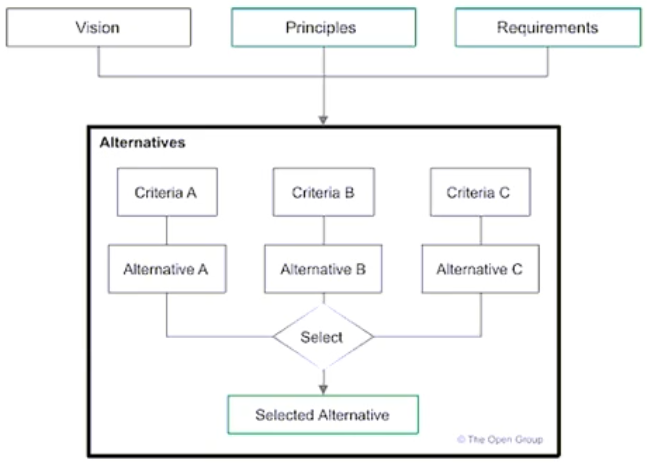
Consider the following graphic from the TOGAF Standard.
What does it illustrate?
AIteration
BThe Architecture Trade-off method
CThe Business Scenario method
DArchitecture Partitioning
What should be established through organizational structures, roles, responsibilities, skills, and processes to perform architectural activity effectively?
AAn EA framework
BAn Enterprise Architecture
CAn EA Capability
DAn EA repository
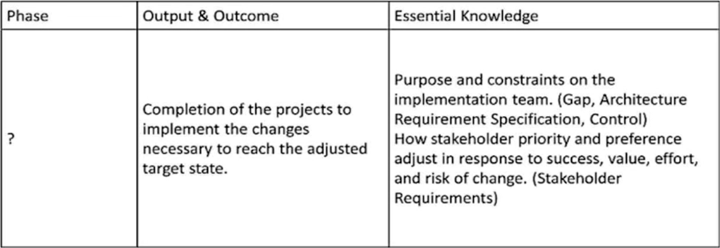
Refer to the table below, which does not identify the ADM phase.
| ? | Completion of the projects to implement the changes necessary to reach the adjusted target state. | - Purpose and constraints on the implementation team. (Gap, Architecture Requirement Specification, Control)
How stakeholder priority and preference adjust in response to success, value, effort, and risk of change. (Stakeholder Requirements) |
Which ADM Phase does this table describe?
APhase E
BPhase A
CPhase G
DPhase F
Refer to the scenario.
You have been asked to explain how you will begin the architecture project.
Based on the TOGAF Standard, which of the following is the best answer?
AYou would gather information from your suppliers and conduct a series of briefings with those of them that are on the current approved supplier list. Based on the findings from the research, you would define a preliminary Architecture Vision including summary views, high-level requirements, and high-level definitions of the baseline and target environments from a business, information systems, and technology perspective. You would then use the Architecture Vision to build agreement among the key stakeholders.
BYou would develop baseline and target Architectures for each manufacturing plant, ensuring that the views corresponding to selected viewpoints address key concerns of the stakeholders. A business case, together with performance metrics and measures should be defined to ensure the architecture meets the business needs. A consolidated gap analysis between the architectures will then validate the approach and determine the capability increments needed to achieve the target state.
CYou would start a test project that will allow your suppliers to demonstrate potential off-the-shelf solutions that address the concerns of the stakeholders. Trying out a test project will save time and money later on. After looking at the results of that test project, a complete set of requirements can then be made that will guide the evolution of the architecture. Once the requirements are completed, there should be a formal stakeholder review, and permission asked to move forward to develop the target architecture.
DYou would conduct a series of interviews at each manufacturing plant using the business scenarios technique. This will help you understand the systems and integrations with local partners. Stakeholder analysis will be used to identify key people involved and their concerns. Next, you will then determine and record the main stakeholder requirements for the architecture. Finally, you will then create clear high-level descriptions of the current and future architectures.
According to the TOGAF standard, which term refers to an individual who has an interest in a system?
Astakeholder
Bconsumer
Clead architect
Dsponsor
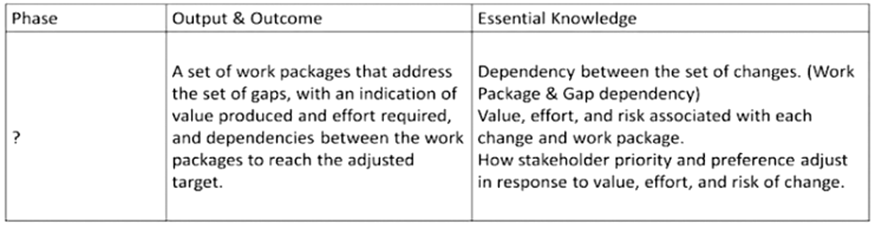
Refer to the table below:
Which ADM phase(s) does this describe?
APhase E
BPhase F
CPhase A
DPhase B, C and D
Which option best summarizes the purpose of Enterprise Architecture?
ATaking major improvement decisions.
BControlling the bigger changes.
CGuiding effective change.
DGoverning the Stakeholders.
Complete the sentence: A business scenario outlines _______.
Abusiness domain gaps, such as cross-training requirements
Bshortfalls between the Baseline and Target Architectures
Cgeneral rules and guidelines for the architecture being developed
Dbusiness and technology environment in which those problems occur
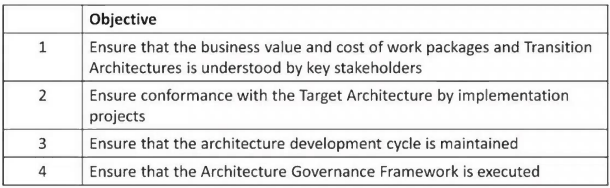
Consider the following objectives for ADM phases.
Which phase corresponds to each objective?
A1E-2E-3F-4F
B1E-2F-3E-4F
C1G-2E-3F-4F
D1F-2E-3F-4G
With reference to the scenario, you have been asked to respond to the CIO by recommending an approach that enables the development of an architecture addressing both the CIO’s concerns and the partners’ concerns.
Based on the TOGAF Standard, which of the following is the best answer?
AYou recommend that all possible models be created for each candidate architecture that will enable the AI and Machine Learning solution. This ensures that all the necessary data and detail is addressed. A formal review should be held with the stakeholders to verify that their concerns have been properly addressed by the models. Agility will be considered during Phase G Implementation Governance.
BYou recommend that an analysis of the stakeholders is undertaken resulting in documenting the stakeholders and their concerns in a Stakeholder Map. The concerns and relevant views should then be defined for each group and recorded in the Architecture Vision document. The requirements will include risk mitigation through regular assessments. This will also allow a supervised agile implementation of the continuous Machine Learning.
CYou recommend that a Communications Plan be created to address the key stakeholders, the most powerful and influential partners. This plan should include a report that summarizes the key features of the architecture reflecting their requirements. You will check with each key stakeholder that their concerns are being addressed. Risk mitigation and agility will be explicitly addressed as a component of the architecture being developed.
DYou recommend creation of a set of business models that can be applied uniformly across all architecture projects. The stakeholders will be trained to understand the business models to ensure they can see that their concerns are being addressed. Risk will be addressed once the Security Architecture is developed, which will happen later to avoid slowing down the agility required by the CIO.
Which of the following most accurately describes a business scenario?
AA technique to quantify readiness for change.
BA technique used to identify business requirements.
CA technique to identify differences between a baseline and target architecture.
DA technique for developing a business model.
Which part of the TOGAF Architecture Principles template should emphasize the business benefits of complying with the principle?
AImplications
BRationale
CStatement
DName
Which of the following statements concerning architecture partitioning is correct?
APartitions reflect the organization's structure.
BPartitions are used to simplify the management of the Enterprise Architecture.
CPartitions are defined and assigned to agile Enterprise Architecture teams.
DPartitions are equivalent to architecture levels.
Which of the following serves as a purpose of Phase A in the TOGAF ADM?
AIdentifying key stakeholders
BDescribing the target architecture
CDefining the Enterprise strategy
DDeveloping an Enterprise Architecture Capability
Which of the following provides support for the need to govern Enterprise Architecture?
AThe TOGAF standard cannot be used without executive governance.
BThe Architecture Project mandates the governance of the target architecture.
CThe Stakeholders preferences may go beyond the architecture project scope and needs control.
DBest practice governance enables the organization to control value realization.
Referring to the scenario, you have been asked to recommend an approach for identifying the work packages for an incremental rollout that meets the requirements.
Based on the TOGAF standard, which of the following is the best answer?
AYou recommend that the Solution Building Blocks from a Consolidated Gaps, Solutions and Dependencies Matrix be grouped into a set of work packages. Using the matrix as a planning tool regroup the work packages to account for dependencies. Sequence the work packages into the Capability Increments needed to achieve the Target Architecture, so that the implementation team can schedule the rollout one region at a time to minimize disruption. Document the work packages for the Enterprise Architecture using a Transition Architecture State Evolution Table.
BYou recommend that the set of required Solution Building Blocks be determined by identifying those which need to be developed and which need to be procured. Eliminate any duplicates. Group the remaining Solution Building Blocks together to create the work packages using a CRUD (create, read, update delete) matrix. Rank the work packages and select the most cost-effective options for inclusion in a series of Transition Architectures Schedule the roll out of the work packages to be sequential across the geographic regions.
CYou recommend that an Implementation Factor Catalog is drawn up to indicate actions and constraints. A Consolidated Gaps, Solutions and Dependencies Matrix should also be created. For each gap identify a proposed solution and classify it as new development purchased solution, or based on an existing product. Group similar activities together to form work packages. Identify dependencies between work packages factoring in the clinical trial schedules. Regroup the work packages into a set of Capability Increments scheduled into a series of Transition Architectures.
DYou recommend that a Consolidated Gaps, Solutions and Dependencies Matrix is used as a planning tool for creating work packages. For each gap classify whether the solution is either a new development, purchased solution, or based on an existing product. Group the similar solutions together to define the work packages. Regroup the work packages into a set of Capability Increments to transition to the Target Architecture considering the schedule for clinical trials, and document in an Architecture Definition Increments Table.
What role does an Architecture Board perform?
AIt determines the scope of an architecture compliance review.
BIt oversees implementation of the Architecture Governance strategy for the enterprise.
CIt conducts the assessments of the maturity level of architecture discipline within the organization.
DIt creates the Statement of Architecture Work for an Enterprise Architecture project.
Consider these statements about the TOGAF ADM:
All ADM activities take place within an iterative cycle of continuous architecture definition and realization.
Requirements Management is a continuous phase.
An output from an earlier phase can be changed in a later phase.
When a phase begins, the preceding phase closes.
Which statements are correct?
A2, 3 & 4
B1, 2 & 3
C1, 3 & 4
D1, 2 & 4
Consider this description of the purpose of an ADM Phase:
> To create a domain architecture that stakeholders approve for the problem being addressed, along with a set of gaps and work to resolve the gaps that stakeholders understand.
Which ADM Phase is being described?
APhase A
BPreliminary Phase
CPhase E
DPhase B
Consider the objectives of the following ADM phases.


Community Discussion