Certified MuleSoft Developer Practice Exam — Free Online Test
QuestionQ1
Design and implement API-led integrations
Save question
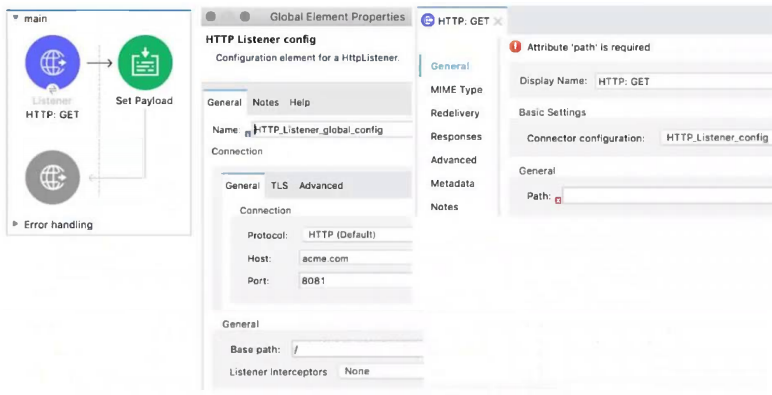
Refer to the exhibits.
The Mule application implements a REST API that accepts GET requests from web clients at these URLs: http://acme.com/order/status and http://acme.com/customer/status.
Which path value can be configured in the HTTP: GET event source to accept web-client requests from both URLs?
A?[order, customer]/status
B*status
C*[order, customer]/status
D*/status
0
Community Discussion
No comments yet. Be the first to start the discussion!
QuestionQ5
Manage event flow, handle errors, and process batch records
0
Community Discussion
No comments yet. Be the first to start the discussion!
QuestionQ6
Manage event flow, handle errors, and process batch records
0
Community Discussion
No comments yet. Be the first to start the discussion!
QuestionQ7
Manage event flow, handle errors, and process batch records
0
Community Discussion
No comments yet. Be the first to start the discussion!
QuestionQ8
Design and implement API-led integrations
0
Community Discussion
No comments yet. Be the first to start the discussion!
That's the end of the preview
It's free
100% of the questions are free for all users. No strings attached.
Design and implement API-led integrationsTransform and format data with DataWeaveConnect applications and data sources such as databases, files, SaaS apps, and messaging queuesManage event flow, handle errors, and process batch records
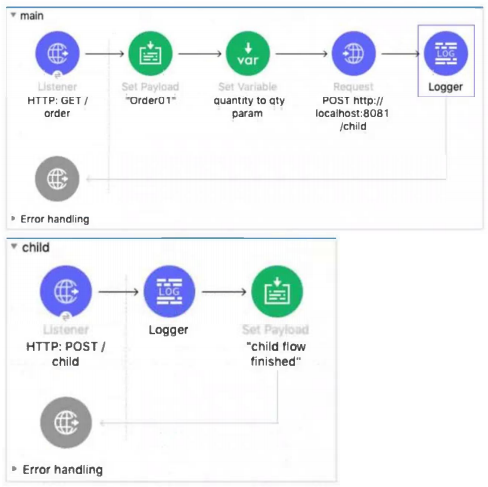
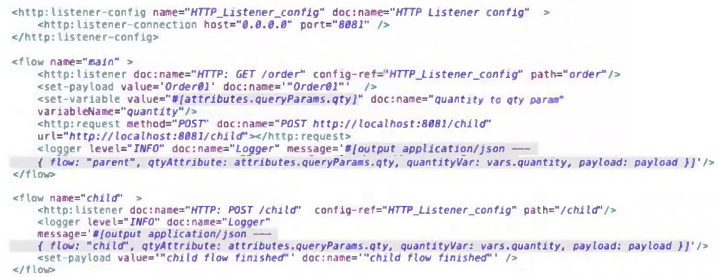
The main flow includes an HTTP Request operation configured to call the child flow's HTTP Listener. A web client sends a GET request to the HTTP Listener with the qty query parameter set to 30.
After the HTTP Request operation completes, which portions of the Mule event at the main flow's Logger component are unchanged from the Mule event that entered the HTTP Request operation?
AThe payload and all variables
BThe entire Mule event
CThe payload and all attributes
DAll variables
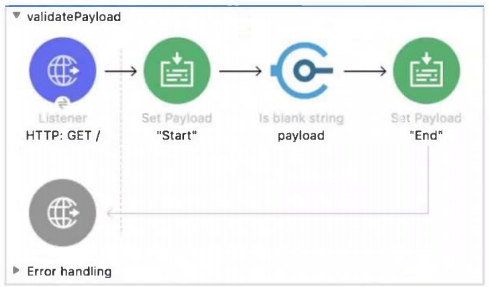
Refer to the exhibits.
The Mule application does not define any global error-handler elements. A web client submits a GET request to the HTTP Listener. Which response message is returned to the web client?
A“”
B“End”
C“String is not blank”
D“Start”
Refer to the exhibits.
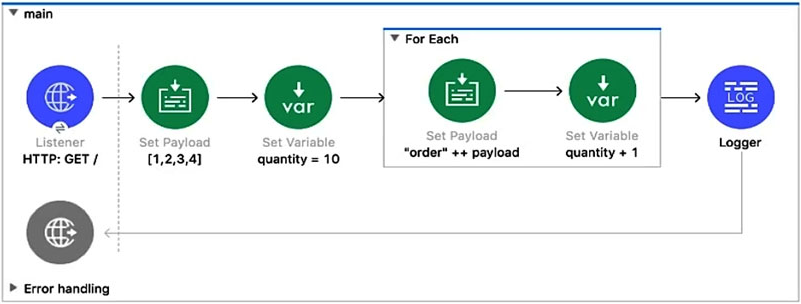
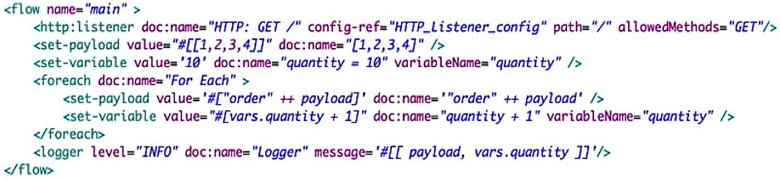
What payload and quantity values are logged at the end of the main flow?
A[[order1, order2, order3, order4],14]
B[[1,2,3,4],10]
C[order1order2order3order4, 14]
D[[1,2,3,4]14]
Northern Trail Outfitter’s Center for Enablement (C4E) has created foundational assets—API specifications and implementation templates, common frameworks, and best-practice guides—and published them to Anypoint Exchange.
Which metric associated with these foundational assets helps NTO assess the success of its C4E efforts?
AUtilization counts of foundational assets in production applications
BCorrelation of key performance indicators (KPIs) of production applications with foundational assets
CCorrelation of each foundational asset with the counts of developers that downloaded each asset
DCounts of how many lines of businesses (LoBs) consumed each foundational asset
QuestionQ9
Connect applications and data sources such as databases, files, SaaS apps, and messaging queues
0
Community Discussion
No comments yet. Be the first to start the discussion!
QuestionQ10
Design and implement API-led integrations
QuestionQ11
Transform and format data with DataWeave
QuestionQ12
Transform and format data with DataWeave
QuestionQ13
Connect applications and data sources such as databases, files, SaaS apps, and messaging queues
QuestionQ14
Connect applications and data sources such as databases, files, SaaS apps, and messaging queues
QuestionQ15
Design and implement API-led integrations
QuestionQ16
Connect applications and data sources such as databases, files, SaaS apps, and messaging queues
QuestionQ17
Connect applications and data sources such as databases, files, SaaS apps, and messaging queues
QuestionQ19
Design and implement API-led integrations
QuestionQ20
Transform and format data with DataWeave
QuestionQ21
Design and implement API-led integrations
QuestionQ22
Manage event flow, handle errors, and process batch records
QuestionQ23
Manage event flow, handle errors, and process batch records
Save question
0
Community Discussion
No comments yet. Be the first to start the discussion!
Save question
0
Community Discussion
No comments yet. Be the first to start the discussion!
Save question
0
Community Discussion
No comments yet. Be the first to start the discussion!
Save question
0
Community Discussion
No comments yet. Be the first to start the discussion!
Save question
0
Community Discussion
No comments yet. Be the first to start the discussion!
Save question
0
Community Discussion
No comments yet. Be the first to start the discussion!
Save question
0
Community Discussion
No comments yet. Be the first to start the discussion!
Ad
Want a break from the ads?
Go ad-free and unlock Learn Mode, Exam Mode, AstroTutor AI and every premium tool — everything you need to walk in prepared, and confident.
No comments yet. Be the first to start the discussion!
Save question
0
Community Discussion
No comments yet. Be the first to start the discussion!
Save question
0
Community Discussion
No comments yet. Be the first to start the discussion!
Save question
0
Community Discussion
No comments yet. Be the first to start the discussion!
Save question
0
Community Discussion
No comments yet. Be the first to start the discussion!
Save question
0
Community Discussion
No comments yet. Be the first to start the discussion!
A Mule application includes an ActiveMQ JMS dependency and was successfully developed in Anypoint Studio.
The Mule application now needs to be exported from Anypoint Studio and shared with another developer.
Which export options produce the smallest JAR file that the other developer can import into Anypoint Studio and run successfully?
AAttach project sources -Include project modules and dependencies
BAttach project sources -Include project modules and dependencies
CAttach project sources -Include project modules and dependencies
DAttach project sources -Include project modules end dependencies
A Mule application configured with autodiscovery implements an API.
Where are the policies defined for this Mule application enforced?
AIn the Mule application
BIn API Manager
CIn a separate API proxy application
DIn Runtime Manager
What is the return type of the DataWeave flatten function?
AObject
BJava
CArray
DMap
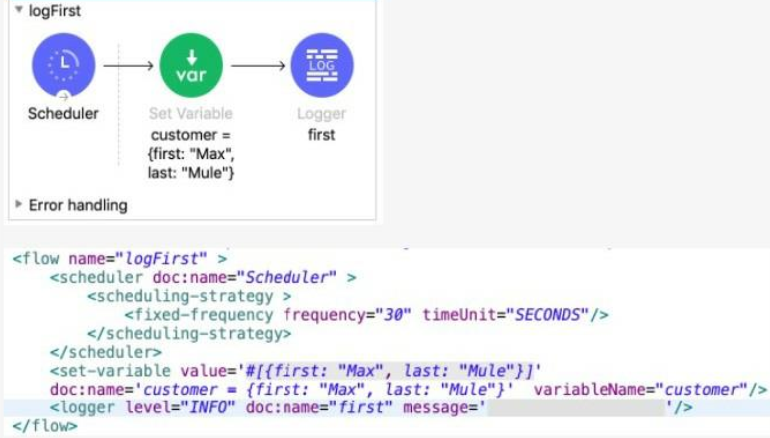
Refer to the exhibits shown.
The Set Variable transformer is configured with a value.
What is a valid DataWeave expression to set as the Logger’s message attribute in order to access the value “Max” from the Mule event?
A“customer.first”
Bcustomer.first
Cvars.“customer”.“first”
Dvars.“customer.first”
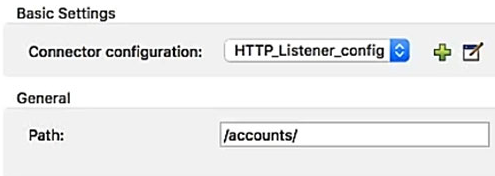
Refer to the exhibit.
What is the proper syntax for adding a customer ID as a URI parameter in an HTTP Listener’s Path attribute?
A[customerID]
B#[customerID]
C$[customerID]
D{customerID}
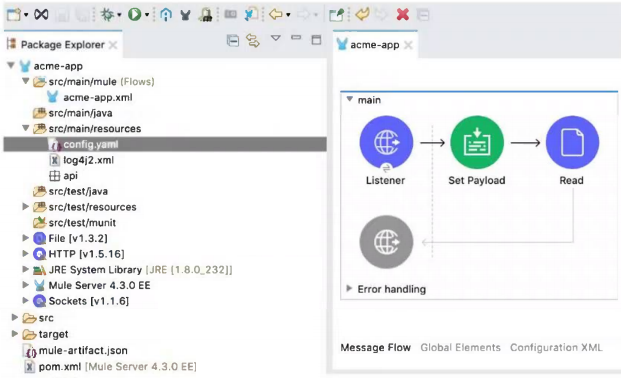
Refer to the exhibit.
The Mule application's connectors are configured with property placeholders whose values are defined in the config.yaml file. What must be added to the Mule application to link the values in config.yaml to the property placeholders?
AA file-config element in the acme-app.xml file.
BA propertiesFile key/value pair in the mule-artifact.json file.
CA configuration-properties element in the acme-app.xml file
DA dependency element in the pom.xml file.
A REST Connect module is generated from a RAML specification and is then imported into a Mule application.
For every method in the RAML specification, what does the REST Connect module provide?
AAn event source
BAn operation
CA flow
DA scope
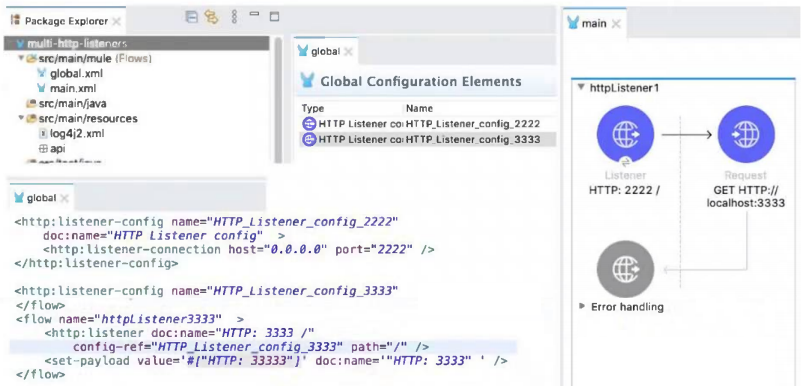
Refer to the exhibits.
A Mule application configures and uses two HTTP Listener global configuration elements. The Mule application runs in Anypoint Studio.
If the Mule application starts successfully, which URI and port number(s) can receive web-client requests; if it fails to start, what causes the failure?
AThe Mule application starts successfully.Web client requests can only be received at the URI / on port 2222, not on port 3333.
BThe Mule application fails to start.There is a port bind conflict because the HTTP Request also uses port 3333.
CThe Mule application starts successfully.Web client requests can be received at the URI / on port 2222 or port 3333.
DThe Mule application fails to start.There is a URL path conflict because both HTTP Listeners are configured with the same path.
By default, what occurs to a file after it is read by using an FTP connector Read operation?
AThe file stays in the same folder unchanged
BThe file is deleted from the folder
CThe file is renamed in the same folder
DThe file is moved to a different folder
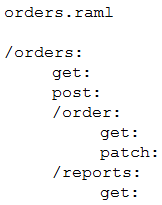
Refer to the exhibit.
APIkit is used to generate flow components from the RAML specification. How many apikit:router XML elements are generated to handle requests for every endpoint defined in the RAML specification?
A3
B2
C1
D5
A function named toUpper must be defined that accepts a string named userName and returns the string in uppercase.
What is the correct DataWeave code for defining the toUpper function?
Avar toUpper(username) –> upper(userName)
Bvar toUpper(username) = upper(userName)
Cfun toUpper(username) = upper(userName)
Dfun toUpper(username) –> upper(userName)
Any Airlines is starting to follow MuleSoft’s recommended API-led connectivity approach, using modern APIs to support the development and lifecycles of its integration solutions and to close the IT delivery gap.
What differentiates how modern APIs are organized in MuleSoft’s recommended API-led connectivity approach from other common enterprise integration solutions?
AThe API implementations are monitored with common tools, centralized monitoring, and security systems
BThe API implementations are built with standards using common lifecycle and centralized configuration management tools
CThe API interfaces are specified as macroservices, with one API representing all the business logic of an existing and proven end-to-end integration solution
DThe API interfaces are specified at a granularity intended for developers to consume specific aspects of integration processes
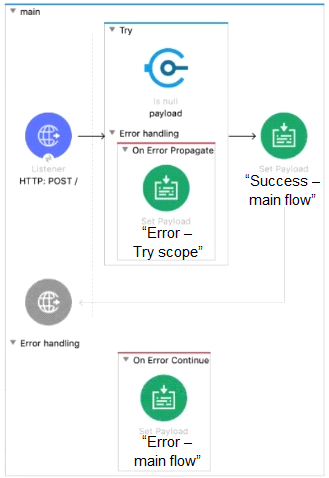
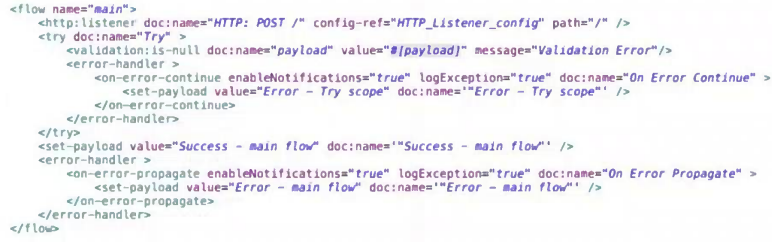
See the exhibits.
The Mule application does not define any global error handlers. The Validation component inside the Try scope throws an error.
Which response message is returned to a client request sent to the main flow’s HTTP Listener?
A“Error – main flow”
B“Success – main flow”
CValidation Error
D“Error – Try scope”
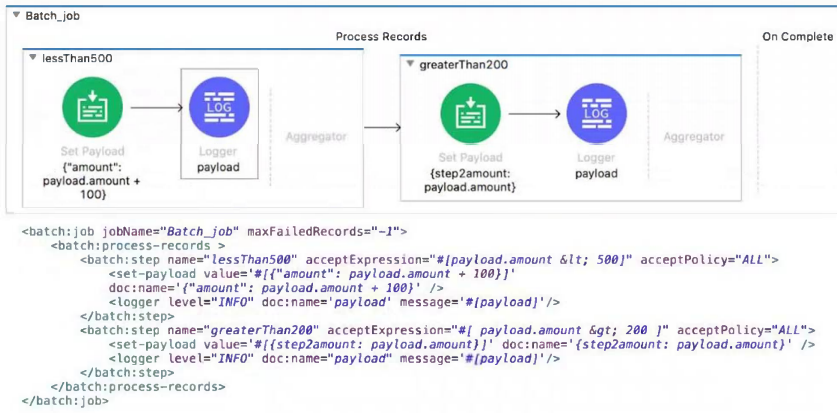
Refer to the exhibits.
The Batch Job scope includes two Batch Step scopes with different acceptance expressions. The input payload is passed into the Batch Job scope.
After the Batch Job scope has processed the complete payload, which messages have the Logger components logged?



Community Discussion