PMI-RMP: PMI Risk Management Professional PMI Practice Exam
QuestionQ1
Risk Strategy and Planning
Save question
A risk manager arranges a project-overview meeting with the project sponsor to give an update on risk-management progress. Each functional lead is identifying the most critical information to present at the executive level. The information must balance communicating essential details with actions and recommendations.
What risk information should be communicated to the project sponsor?
ASignificant risks and issues and their planned responses
BRisk matrix showing the distribution of high, medium, and low risks
CResults of the last project risk brainstorming session
DSummary feedback from the previous risk audit
0
Community Discussion
No comments yet. Be the first to start the discussion!
QuestionQ2
Risk Strategy and Planning
0
Community Discussion
No comments yet. Be the first to start the discussion!
QuestionQ3
Risk Response
0
Community Discussion
No comments yet. Be the first to start the discussion!
QuestionQ4
Monitor and Close Risks
0
Community Discussion
No comments yet. Be the first to start the discussion!
QuestionQ5
Risk Strategy and Planning
0
Community Discussion
No comments yet. Be the first to start the discussion!
It's free
100% of the questions are free for all users. No strings attached.
A project team’s risk facilitator has identified several risks and must prioritize them according to the organization’s risk-appetite levels. Which technique should be used?
APERT
BStakeholder risk profile analysis
CProject scope statement analysis
DMonte Carlo technique
During risk identification for a construction project, insufficient space to install air conditioners is identified as a high-impact risk. Which option is an example of an early risk trigger?
AA quality nonconformance issue raised during the inspection
BA time delay during air conditioning installation activities
CA potential need to share the space with other machinery
DA different type of equipment received before installation
At the end of a small project, the risk manager conducts a risk audit and discovers that several identified risks occurred, with impacts significantly greater than anticipated. Although the project stayed on schedule, its budget rose by 50%. The project achieved all risk-response milestones, and no additional, previously unidentified risks occurred during the project.
Based on this information, which risk management process improvement should the risk manager recommend for future similar projects?
AIncrease frequency of risk management meetings with the project manager.
BRevise the level of accuracy of probability and impact scores.
CDocument the risk audit report and capture it in the lessons learned database.
DExpand the use of risk identification techniques.
A project manager is assigned to a project that is only beginning. Because of budget and schedule constraints, the organization has a very low risk appetite for this project. Project stakeholders are highly engaged and want clear visibility into project risks and progress.
How should the project manager manage stakeholder expectations?
ADiscuss the risk response strategies with the stakeholders.
BEnsure the risk register includes all identified risks.
CDevelop a communication plan to share updates on risks.
DAdd buffers to the schedule to accommodate risk.
QuestionQ6
Risk Identification
0
Community Discussion
No comments yet. Be the first to start the discussion!
QuestionQ7
Risk Response
QuestionQ8
Risk Strategy and Planning
QuestionQ9
Risk Response
QuestionQ10
Risk Strategy and Planning
QuestionQ11
Risk Response
QuestionQ12
Risk Response
QuestionQ13
Risk Identification
QuestionQ14
Risk Response
QuestionQ15
Risk Strategy and Planning
QuestionQ16
Risk Identification
QuestionQ17
Risk Identification
QuestionQ18
Risk Response
QuestionQ19
Monitor and Close Risks
QuestionQ20
Risk Response
QuestionQ21
Risk Analysis
QuestionQ22
Risk Response
QuestionQ23
Risk Analysis
QuestionQ25
Risk Response
QuestionQ26
Risk Response
Save question
0
Community Discussion
No comments yet. Be the first to start the discussion!
Save question
0
Community Discussion
No comments yet. Be the first to start the discussion!
Save question
0
Community Discussion
No comments yet. Be the first to start the discussion!
Save question
0
Community Discussion
No comments yet. Be the first to start the discussion!
Save question
0
Community Discussion
No comments yet. Be the first to start the discussion!
Save question
0
Community Discussion
No comments yet. Be the first to start the discussion!
Save question
0
Community Discussion
No comments yet. Be the first to start the discussion!
Ad
Want a break from the ads?
Go ad-free and unlock Learn Mode, Exam Mode, AstroTutor AI and every premium tool — everything you need to walk in prepared, and confident.
No comments yet. Be the first to start the discussion!
Save question
0
Community Discussion
No comments yet. Be the first to start the discussion!
Save question
0
Community Discussion
No comments yet. Be the first to start the discussion!
Save question
0
Community Discussion
No comments yet. Be the first to start the discussion!
Save question
0
Community Discussion
No comments yet. Be the first to start the discussion!
Save question
0
Community Discussion
No comments yet. Be the first to start the discussion!
Save question
0
Community Discussion
No comments yet. Be the first to start the discussion!
Save question
0
Community Discussion
No comments yet. Be the first to start the discussion!
Save question
0
Community Discussion
No comments yet. Be the first to start the discussion!
Save question
0
Community Discussion
No comments yet. Be the first to start the discussion!
Save question
0
Community Discussion
No comments yet. Be the first to start the discussion!
Save question
0
Community Discussion
No comments yet. Be the first to start the discussion!
An organization is running two projects—Project A and Project B—at the same time. A previously identified risk will affect Project A’s schedule. During execution of the mitigation plan, several residual risks are identified that could result in cost savings for Project B.
What action should Project A’s risk manager take?
AContinue executing the planned risk mitigation to avoid any additional schedule impact to Project A.
BCombine the risk registers for Project A and Project B and determine if there are any additional cross-project opportunities to exploit.
CConsult with Project B's risk manager and determine where synergies might exist between the risk management plans for both projects.
DReview the findings in Project A's closure documents and propose a new organizational process for portfolio risk management.
While overseeing risks on an infrastructure improvement project, the risk manager applies certain techniques to help ensure effective responses to risks that have already materialized.
Which of the following is an example of such a technique?
ARisk analysis and performance reports preparation
BOngoing risk response analysis and risk audits as required
CRisk analysis and risk register review
DRisk audits and change request review
A highly complex project is about to begin. Because numerous changes and new information will emerge as the work progresses, key stakeholders are concerned that risks may not be addressed in a timely manner.
What should the risk manager do in this situation?
AEstablish a formal and upfront risk identification process.
BAdopt a dynamic and frequent risk management process.
CUse a detailed and quantitative risk assessment process.
DCreate an effective and clear risk communication process.
A risk manager encounters resistance while attempting to implement the project’s risk strategy. Some project team members believe it wastes time and money.
What should the risk manager do?
AContinue to implement the risk strategy.
BReduce the number of risk management activities.
CMeet with team members to address their concerns.
DRaise the concerns with the project sponsor.
What are the critical success factors for the Plan Risk Management process?
AMitigate all risks, engage stakeholders, and follow organizational policies.
BIdentify and address barriers, engage stakeholders, and follow organizational policies.
CContingency reserves engage stakeholders and follow organizational policies.
DIdentify and address barriers, engage stakeholders, and follow government regulations.
A key hardware component failed during a large software implementation project, causing significant organizational impact. The risk owner was on vacation, and nobody responded to the incident, resulting in project delays.
What should have been done to avoid this situation?
AThe risk manager should have taken the responsibility of responding to this risk instead of relying on and waiting for the risk owner to return from vacation.
BThe risk owner should have communicated with the project manager so that a designated stakeholder could have been assigned to accept accountability for implementing risk responses.
CThe risk manager should have anticipated this situation and planned for schedule buffers in the project schedule to accommodate the likelihood of failed hardware.
DThe project manager should have requested and mandated that no vacations be taken during critical implementation activities or until all implementation had been completed for the project.
During the monthly executive review meeting, the project sponsor wants to understand how the project team plans to manage risks identified at the previous meeting. What should the project manager do?
AReact to the secondary and residual risks only if they occur.
BInclude secondary and residual risks as part of the response.
CTransfer secondary and residual risks to the project sponsor.
DUtilize a Monte Carlo assessment to provide risk related impacts.
A risk manager on a hospital extension project is guiding the project team as it develops a risk management plan. One team member is responsible for performing risk identification. The team member has just joined the team and is finding it difficult to ensure coverage of every risk that could arise in this complex project.
How should the risk manager address this concern?
ADevelop a probability and impact matrix to analyze possible risks.
BDevelop a risk impact analysis to assess the consequences of possible risks.
CCreate a risk register to capture and track possible risks.
DDevelop a risk breakdown structure (RBS) to identify possible risks.
The engineering department has offered the project manager access to highly-skilled resources at the same cost as the resources currently assigned to the project. What should the project manager do next to address this situation?
ACreate a change request to prevent a delay in getting the resources hired.
BAnalyze the impact of replacing the resources and exploit the opportunity.
CDecline, to avoid changes in project team setup and stakeholder disruption.
DAccept the resources, to ensure project efficiency improvement is gained from the new resources.
Near the end of definitive design, project costs have risen to the level at which it will be categorized as a capital asset project. The customer has stated that they want one final overall project-completion date and will allow no extensions once it is set.
How should the risk manager proceed?
AUpdate the assumptions/exclusions register with the new information.
BUpdate the risk register and prepare for the Monte Carlo analysis.
CPerform a quantitative risk analysis and update the results.
DPerform a qualitative risk analysis and update the results.
After returning from vacation, the risk manager notices during the project status meeting that several activities being performed were not included in the original plan.
What should the risk manager do first?
AMeet with the project team.
BInform management of out-of-scope work.
CReview activities for new risks.
DReview the change control log.
A risk manager collaborates with the project team, senior management team, subject matter experts, and other stakeholders to identify project risks. Which tool or method in the risk management plan can be used to identify a risk based on project objectives by category?
AAffinity diagram
BRisk breakdown structure
CDecision tree method
DWork breakdown structure
While planning for the project execution phase, stakeholders are deciding how to respond to known and newly identified risks. Which artifact should the stakeholders prepare?
AAssumption log
BRisk-adjusted back log
CIssue log
DChange log
A project manager is managing a high-priority, high-profile project. The project team identified three opportunities and, following analysis, documented risk responses. Although the risk responses were sufficient for the identified opportunities, two of those opportunities were not acted on. During the risk audit, the project manager discovered that several planned risk responses had not been implemented.
What should the project manager have done to prevent this?
AUpdated the project schedule, adding risk owner implementation tasks.
BDetermined risk triggers and thresholds in the risk response plan.
CProvided regular training to the risk owners for plan implementation.
DIncreased communications to influence stakeholder risk responses.
A project team has finished the risk-identification steps and compiled a list of 25 risks. The team wants to develop response plans for every risk to prevent future issues, but available resources and constraints limit the options.
What should the risk manager do?
APerform a constraint analysis.
BPerform a sensitivity analysis.
CPerform a root-cause analysis.
DPerform a qualitative risk analysis.
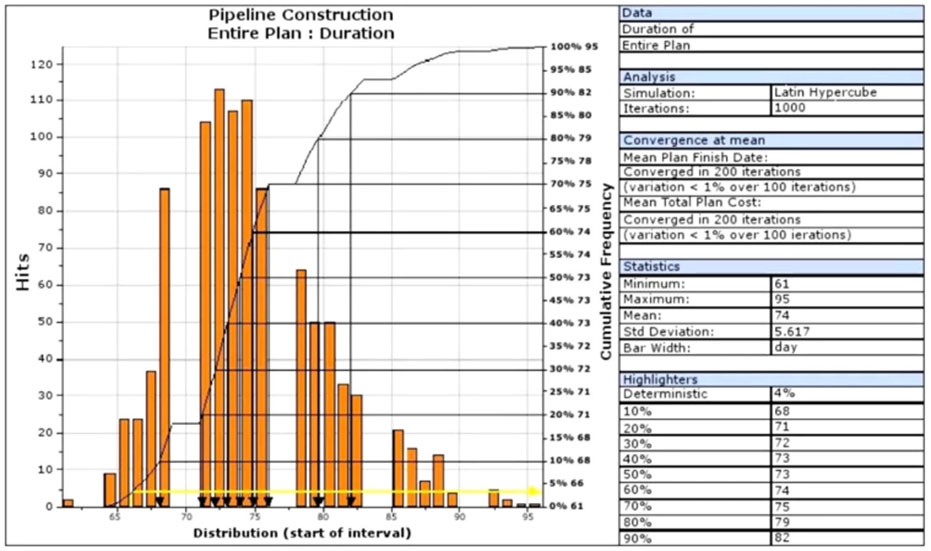
The project manager has requested the P50 estimate for the project schedule. What is the P50 estimate?
A75 days
B73.5 days
C73 days
D72.5 days
During a project to promote public health and reduce health risks, national health authorities plan to limit the risks from harmful insects by using pesticides. Some residents are expected to experience negative health effects from the pesticides; however, the health authorities’ assessment indicates that not proceeding with the plan would have far more serious public-health consequences than carrying out the original plan.
How should the project manager address this concern with the health authorities?
AAssess and record associated secondary risks and proceed to treat them as any other risks.
BConsult with health experts to provide a risk trigger before using pesticides that will impact the residents.
CProceed with the project as normal since a minor number of residents will be affected negatively.
DSuspend the project as the secondary risk will negatively impact residents’ health which is not acceptable.
A project team determines that a key project milestone could be missed. The team wants to proceed with risk response planning.
What should the risk manager complete first?
AThe risk categorization
BThe full risk description
CThe risk response plan
DThe risk simulation
A change advisory board did not approve a requested change because alternative actions were missing if implementation failed. Which of the following should be updated before approval is requested again?
AScope of change
BRisk level
CRollback plan
DEnd user acceptance
While processing freight invoices for a project, the project manager finds that shipping costs exceeded the budget because of increased fuel costs. The risk manager had included this risk in the project’s contingency allowance. While reviewing project budget-execution reports, the project manager identifies unused budget remaining in other closed project tasks that could cover the extra shipping costs.
What should the project manager do?
AAsk the project sponsor to cover the additional shipping costs on the company’s reserves account.
BProcess the freight invoices at higher shipping costs against the project’s contingency allowance.
CRequest a formal change order from the customer to increase the project’s total budget.
DProcess the freight invoices for the budgeted amount and hope the shipping company will forgive the difference.

Community Discussion