Which three are prerequisites for using Data Guard Broker? (Choose three.)
AA statically defined listener end-point must be registered with the local listener on the servers hosting the standby database instances.
BNetwork connectivity to the primary database instance must be defined on the servers hosting the standby database instances.
CThe primary and standby databases must run the same version of the Oracle Database server.
DThe broker configuration files for a RAC database must reside in shared storage accessible by all the RAC database instances.
EIf any database in the configuration in a RAC database, then the broker configuration files must reside in shared storage accessible by all database instances for all databases in the broker configuration.
FDG_BROKER_START must be set to TRUE for a database instance before adding the database to the broker configuration.
Examine this command executed on a physical standby database to transition it to a logical standby database:
SQL> ALTER DATABASE RECOVER TO LOGICAL STANDBY prodlgsby;
Which two statements are true regarding the execution of this command? (Choose two.)
AThe Managed Recovery Process (MRP0) continues applying redo data to the physical standby database until it is ready for conversion to a logical standby database.
BSQL apply is automatically started when transitioning to the logical standby database.
CSupplemental logging will be enabled on the logical standby database when the physical standby database is transitioned to the logical standby database.
DThe DBID of the database is changed.
EFLASHBACK is automatically enabled when transitioning the logical standby database.
FIt will automatically start redo apply.
Which three are true about the rolling release upgrade method for Data Guard environments using a transient Logical Standby database? (Choose three.)
AA rolling release upgrade can be performed with the Data Guard environment in any protection mode.
BThe original primary database can ship redo to any standby database that is part of the Data Guard configuration during the rolling release upgrade process.
CThe transient logical standby database used for the rolling release upgrade must have the same DBID as the primary database.
DThe transient logical standby database used for the rolling release upgrade can run with a newer version of the Oracle software than the primary database.
ESELECT GUARD_STATUS FROM V$DATABASE; must return NONE as a prerequisite for the rolling release upgrade with a transient logical standby database.
You must configure an Oracle Data Guard environment consisting of:
A primary database
Two physical standby databases
Examine these requirements:
Data loss is not permitted.
It should be possible to convert either of the physical standby databases to a snapshot standby database.
Under normal operations, transactions should not commit before redo is written to disk on both the primary database and at least on one standby database.
The availability of the primary database should not be compromised by the availability of the standby databases.
It should be possible to enable fast-start failover.
It should be possible to deploy Real Application Clusters on all databases.
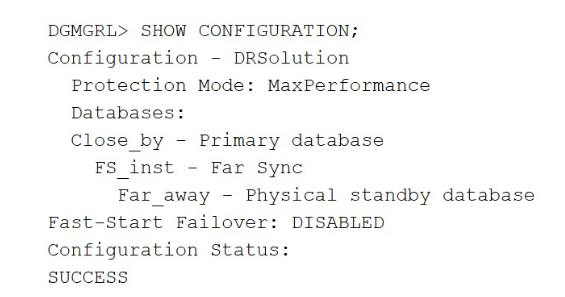
You configure FASTSYNC redo transport mode to both standby databases in combination with Maximum Availability mode.
Which requirements will you meet?
A2, 4, 5, and 6
B2, 4, and 5
C2, 3, 4, 5, and 6
D1, 2, 3, 4, 5, and 6
E1, 2, 4, 5, and 6
You must configure an Oracle Data Guard environment consisting of:
A primary database
A physical standby database
Examine these requirements:
Data loss is not permitted.
It should be possible to convert the physical standby database to a snapshot standby database.
Under normal operations, transactions should commit when redo is written to disk on the primary database and as soon as it has been received by the standby database instance.
The availability of the primary database should not be compromised by the availability of the standby database.
It should be possible to convert the physical standby database to a logical standby database.
It should be possible to deploy Real Application Clusters on the primary database.
It should be possible to deploy Real Application Clusters on the physical standby database.
You configure SYNC AFFIRM redo transport mode in combination with Maximum Protection mode.
Which requirements will you meet?
A1, 2, 6, and 7
B1, 2, 3, 4, 5, 6, and 7
C1, 2, and 5
D1, 2, 3, 6, and 7
E1, 6, and 7
Question 6
Performing Role Transitions
0
Question 7
Oracle Data Guard Overview
Question 8
Configuring and Managing Oracle Data Guard Broker
Question 9
Configuring and Managing Oracle Data Guard Broker
Question 10
Performing Role Transitions
Question 11
Managing the Redo Transport Services
Question 12
Monitoring a Data Guard Configuration
Question 13
Oracle Data Guard Overview
Question 14
Managing Log Apply Services
Question 15
Configuring and Managing Oracle Data Guard Broker
Question 16
Oracle Data Guard Overview
Question 17
Configuring and Managing Oracle Data Guard Broker
Question 18
Managing Log Apply Services
Question 19
Configuring and Managing Oracle Data Guard Broker
Question 20
Managing Log Apply Services
Question 21
Oracle Data Guard Overview
Question 22
Managing Log Apply Services
Question 23
Managing Log Apply Services
Question 24
Managing the Redo Transport Services
Question 25
Managing Log Apply Services
Ask AstroTutor
0
Ask AstroTutor
0
Ask AstroTutor
0
Ask AstroTutor
0
Ask AstroTutor
0
Ask AstroTutor
0
Ask AstroTutor
0
Ad
Want a break from the ads?
Become a Supporter and enjoy a completely ad-free experience, plus unlock Learn Mode, Exam Mode, AstroTutor AI, and more.
Ask AstroTutor
0
Ask AstroTutor
0
Ask AstroTutor
0
Ask AstroTutor
0
Ask AstroTutor
0
Ask AstroTutor
0
Ask AstroTutor
0
Ask AstroTutor
0
Ask AstroTutor
0
Ask AstroTutor
0
Ask AstroTutor
0
Ask AstroTutor
0
Which three are true about using Flashback database through role transitions in a Data Guard environment? (Choose three.)
APhysical standby databases retain their current role when you flash back to a point in time before a reinstate occurred which caused this database to become a physical standby.
BPhysical standby databases retain their current role when you flash back to a point in time before the switchover occurred which caused this database to become a physical standby.
CLogical standby database roles are reverted to their original role when you flash back to a point in time before the switchover occurred which caused this database to become a logical standby.
DFlashback database may not be used to undo a physical standby database activation.
ELogical standby databases retain their current role when you flash back through to a point in time before the switchover occurred which caused this database to become a logical standby.
Which TWO statements are true for Data Guard environments with multi-tenant databases? (Choose two.)
AThe Data Guard broker automatically always opens the pluggable databases of a standby database after a role change operation.
BThe Data Guard broker automatically opens all pluggable databases of a primary database after a role change operation.
CDifferent pluggable databases within a logical standby database may have different guard statuses.
DA multi-tenant standby database can have fewer pluggable databases than the primary container database.
EThe CDBDBA privilege must be used instead of the SYSDBA privilege for connections as SYS to the root container of a multi-tenant standby database.
You created a physical standby database PRODSBY1 from the primary database PROD using SQL and RMAN.
Which THREE are prerequisites for creating a Data Guard Broker configuration to manage these databases? (Choose three.)
AThe primary database must have FORCE LOGGING enabled.
BA local net service name to enable connectivity to the PRODSBY1 database instance must be defined on the primary database host.
CThe DG_BROKER_START parameter must be set to TRUE for both database instances.
DThe standby database must have supplemental logging enabled.
EThe LOG_ARCHIVE_DEST_n parameters with the SERVICE attribute set must be cleared.
FThe primary database must have supplemental logging enabled.
You created the PRODSBY1 physical standby database for the PROD primary database using SQL and RMAN. You are planning to create a Data Guard Broker configuration.
You execute the command:
Which three statements are true regarding the execution of the command? (Choose three.)
AThe PRODSBY1 standby database is automatically added to the configuration if DG_BROKER_START is TRUE for PRODSBY1.
BThe command will execute successfully only if the DG_BROKER_START initialization parameter is set to TRUE for the PROD database instance.
CThe Data Guard Broker configuration files is automatically created in the destinations specified by the DG_BROKER_CONFIG_FILEn initialization parameters on the primary database.
DThe command will execute successfully only if Oracle Net connectivity to the PROD database instance is defined on the primary host.
EThe PRODSBY1 standby database is automatically added to the configuration if Oracle Net connectivity to the PRODSBY1 database instance is defined on the primary host.
FThe command will execute successfully only if Oracle Net connectivity to the PROD and PRODSBY1 database instances are defined on the primary host.
Which three are true concerning database states after a successful switchover? (Choose three.)
AThe former primary database will always be open.
BIn the former primary database became a physical standby database it will always be open read-only.
CIn the former primary database became a logical standby database it will be in mount state.
DThe new primary database will be open read-write.
EIn the former primary database became a logical standby database it will be open read-write.
FIn the former primary database became a physical standby database it will be in the same state as the former physical standby database.
You must configure an Oracle Data Guard environment consisting of:
A primary database
A physical standby database
A snapshot standby database
You must meet these requirements:
A primary database availability should not be compromised by the availability of the standby databases.
Under normal operations, transactions executed on the primary database should not commit before redo is written to disk on the primary database and on at least one standby database.
Which redo transport mode and which protection mode would you configure to meet these requirements?
ASYNC AFFIRM and Maximum Availability
BSYNC NOAFFIRM and Maximum Protection
CASYNC and Maximum Performance
DSYNC AFFIRM and Maximum Protection
ESYNC NOAFFIRM and Maximum Availability
A query on the view DBA_LOGSTDBY_UNSUPPORTED on your primary database returns several rows.
As a result of this, you decide that an upgrade may not use logical standby databases.
Which three are true about upgrading Data Guard environments consisting of one physical standby database running on a separate host from the primary? (Choose three.)
AThe upgrade requires downtime until the upgrade of the primary is completed.
BThe upgrade requires downtime until the upgrade of the standby is completed.
CFast-Start Failover can be used to protect the primary database during the upgrade.
DThe broker must be disabled during the upgrade.
EThe new release of the Oracle software must be installed on both the primary and standby database hosts.
FWith manual upgrade, catupgrd.sql can be executed on the primary and standby databases simultaneously.
You must propose an Oracle Data Giard configuration for a database supporting an OLTP workload that meets these permanent requirements:
Data loss is not permitted.
Read-only applications should not connect to the primary database instance.
Additionally, there are these requirements, only one of which is ever done at any one time:
It should be possible to apply and test designed patches with a minimum amount of downtime.
Upgrading to a new database release should be performed with the least possible amount of downtime.
New application software releases should be tested against an exact up-to-date replica of the production database.
You propose a primary database with one physical database configured in Maximum Protection mode.
Which requirements to you meet?
A1 and 2
B1, 2, 3, 4, and 5
Conly requirement 5
Donly requirement 1
E2, 3, 4, and 5
F1, 2, and 4
You notice the SQL apply lag on your logical standby database has increased but the redo transport lag has not.
Which four could be reasons for the increase in SQL apply lag? (Choose four.)
AAn increased number of bulk inserts on the primary
BThe standby redo log files are undersized on the primary database
CAn undersized undo tablespace on the logical standby
DAn increased number of bulk updates on the primary
EAn undersized shared pool
FMany SQL apply operations do full table scans.
You have a Data Guard broker configuration consisting of:
A primary database
One local physical standby database
One far sync instance
A remote physical standby database
The broker configuration was created DGMGRL utility after creating all the databases and the far sync instance with command-line tools.
What is the correct way to add this configuration to the Enterprise Manager Cloud Control assuming all the nodes have been discovered already as Enterprise Manager targets?
ADiscover the primary as a target by refreshing the node on which it runs, and the other databases and instances in the Data Guard broker configuration will be discovered as targets automatically and be ready to be monitored.
BDiscover the primary databases as a target in Enterprise Manager Cloud Control. Then discover the existing Data Guard Broker configuration for the primary and all the other databases in the configuration will be discovered as targets and be ready to be monitored.
CUse DGMGRL utility to register the configuration with the Enterprise manager Cloud Control agent in the primary database node. This will enable the discovery of all the other databases in the configuration as targets which will be ready to be monitored.
DDelete the Data Guard Broker configuration using DGMGRL and then re-create it using Enterprise Manager Cloud Control to enable all the databases in the configuration to be discovered as targets and to be ready to be monitored.
EDiscover either of the physical standby databases as a target by refreshing the node on which they run, and the other databases and instances in the Data Guard Broker configuration will be discovered as targets automatically and be ready to be monitored.
Which THREE statements are true about snapshot standby databases? (Choose three.)
AA snapshot standby database may be opened read-write.
BA snapshot standby database may be opened read-only.
CFLASHBACK DATABASE is enabled automatically on a physical standby database as part of the conversion into a snapshot standby database, if not already enabled.
DFLASHBACK DATABASE must be manually enabled on a physical standby database before converting it into a snapshot standby database.
EA snapshot standby database can have Real-Time apply enabled.
FFLASHBACK DATABASE is enabled automatically on a snapshot standby database after converting it from a physical standby database if not already enabled.
You have a Data Guard Broker configuration called ‘Somewhere’ as shown:
You then run this command:
DGMGRL> SHOW DATABASE 'Nearby' 'InconsistentProperties';
Which two are true about the output of this DGMGRL command? (Choose two.)
AIt shows all properties whose broker configuration values for database Nearby are inconsistent with the broker configuration values for database Farout.
BAny inconsistency reported is on an instance-specific basis.
CIt shows properties whose broker configuration values for database Nearby are inconsistent with values in the corresponding server parameter file or the runtime values for database instance Nearby.
DA far sync instance cannot have inconsistent properties because it has no database.
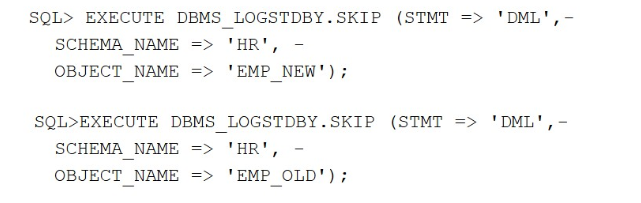
On your logical standby database, you specified these rules:
After completion of the weekend batch cycle, you attempt to delete the SQL Apply filers:
Which TRUE regarding the execution of the UNSKIP procedure?
AIt succeeds but the SQL Apply filters are not deleted.
BIt returns an error because the syntax to delete a SQL Apply filer must specify the same object names as specified when the filter was added.
CIt deletes both the SQL Apply filters.
DIt succeeds only if SQL apply is stopped before deleting the SQL Apply filter.
EIt succeeds only if all DML statements executed on the primary have been applied on the logical standby deleting the SQL Apply filter.
Which two are true about managing and monitoring Oracle container databases in a Data Guard environment using the broker? (Choose two.)
AAll broker actions execute at the root container for container databases.
BIf the primary database is a container database, then a physical standby may be a non-container database.
CAfter a role change, the broker opens all Pluggable databases (PDBs) on the new primary.
DIf the primary database is a container database, then a logical standby may be a non-container database.
EIf the primary database is not a container database, then a standby may be a container database.
Which TWO statements are true about block media recovery in a Data Guard environment? (Choose two.)
ADB_LOST_WRITE_PROTECT must be set to TYPICAL to enable Automatic Block Media Recovery.
BA corrupt block on the primary database can be recovered automatically, using blocks from a physical standby database that has Real-Time Query enabled.
CWhen using RMAN, the RECOVER CORRUPTION LIST command can use blocks from block change tracking files..
DDB_LOST_WRITE_PROTECT must be set to FULL to enable Automatic Block Media Recovery.
EWhen using RMAN, the RECOVER CORRUPTION LIST command can use blocks from block change tracking files.
A customer asks for your opinion about possible solutions for this requirement:
We plan a Data Guard Configuration with one primary and one standby database to protect against any regional disaster.
It is very important that there be no significant performance impact on the primary database.
Reports and backups must be offloaded to the standby database.
Which recommendation would you make?
AThe business requirements are conflicting and no solution is possible
Ba logical standby database with asynchronous redo transport
Ca physical standby database with real-time query operating in Maximum Availability Mode
Da physical standby database with asynchronous redo transport and real-time query to support offloading of reports
You Data Guard environment consists of these components and settings:
A primary database
Two remote physical standby databases
The redo transport mode is set to SYNC
Real-time query is enabled for both standby databases
The DB_BLOCK_CHECKING parameter is set to TRUE on both standby databases
You notice an increase in redo apply lag time on both standby databases.
Which two would you recommend to reduce the redo apply lag on the standby databases? (Choose two.)
ALower DB_BLOCK_CHECKING to MEDIUM or LOW on the standby databases.
BIncrease the size of the buffer cache on the physical standby database instances.
CDecrease the redo log file size on the primary database.
DIncrease the number of standby redo log files on the standby databases.
EIncrease the size of standby redo log files on the standby databases.
You are licensed to use Oracle Active Data Guard.
Which TWO statements are true after enabling block change tracking on a physical standby database? (Choose two.)
AIt allows fast incremental backups to be offloaded to a snapshot standby database, when the physical standby database is converted.
BIt allows fast incremental backups to be taken on the primary database.
CIt starts the CTWR process on the primary database instance.
DIt starts the CTWR process on the physical standby database instance.
EIt starts the RVWR process on the physical standby database instance.
FIt allows fast incremental backups to be offloaded to the physical standby database.
Which two factors can cause an increase in redo transport lag? (Choose two.)
AIncrease in redo generation rate on the primary database.
BThe size of the online redo log files on the primary database.
CThe size of the online redo log files on the standby database.
DIncrease in network latency between the primary database and a redo transport destination.
EThe size of the standby redo log files on the primary database.
A Data Guard environment has this configuration and these attributes:
The primary database prima is in the local region.
A physical standby database physt1 is in the local region.
A physical standby database physt2 is in a remote region.
The primary ships redo to physt1.
physt1 ships redo to physt2.
physt1 and physt2 have Real-Time Query enabled.
A sequence has been created with this SQL statement in the primary database:
CREATE SEQUENCE A NOCACHE SESSION;
Which TWO statements are TRUE? (Choose two.)
Aphyst2 will no longer receive redo if physt1 becomes unavailable, unless LOG_ARCHIVE_DEST_n has the ALTERNATE attribute specified on physt1.
BThe sequence is usable on physt1 but not usable on physt2.
Cphyst2 will no longer receive redo if physt1 becomes unavailable, unless LOG_ARCHIVE_DEST_n has the ALTERNATE attribute specified on the primary database.
DThe sequence is usable on physt1 and physt2.
EThe sequence is usable on physt2 if physt1 becomes unavailable, but only if an alternate redo destination has been configured on the primary database.