BThe primary and recovery file servers must have the same domain name.
COpen TCP port 7515 on all client network IPs (uni-directionally on the source and recovery file servers).
DThe Files Manager must have at least three file servers.
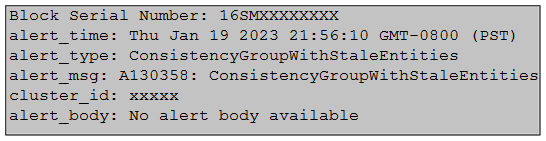
An administrator has received an alert A130358 – ConsistencyGroupWithStaleEntities details of alert as follows:
Which scenario is causing the alert and needs to be addressed to allow the entities to be protected?
AOne or more VMs or Volume Groups belonging to the Consistency Group is part of multiple Recovery Plans configured with a Witness.
BOne or more VMs or Volume Groups belonging to the Consistency Group contains stale metadata.
COne or more VMs or Volume Groups belonging to the Consistency Group may have been deleted.
DThe logical timestamp for one or more of the Volume Group is not consistent between clusters.
What is the binary image extension of File Analytics?
AISO
BQCOW2
CJSON
DVMDK
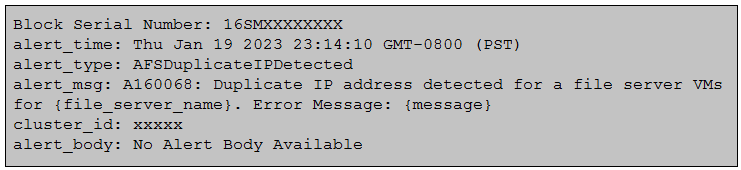
An administrator has received an alert A130351 – VolumeGroupProtectionFailed details of alert as follows:
Which error logs should the administrator be reviewing to determine why the relative service is down?
Asolver.log
Bcerebro.ERROR
Ctcpkill.log
Darithmos.ERROR
Question 6
Section 1 – Deploy and Upgrade Nutanix Unified Storage
0
Question 7
Section 2 – Configure and Utilize Nutanix Unified Storage
Question 8
Section 2 – Configure and Utilize Nutanix Unified Storage
Question 9
Section 4 – Troubleshoot Nutanix Unified Storage
Question 10
Section 2 – Configure and Utilize Nutanix Unified Storage
Question 11
Section 2 – Configure and Utilize Nutanix Unified Storage
Question 12
Section 3 – Analyze and Monitor Unified Storage
Question 13
Section 1 – Deploy and Upgrade Nutanix Unified Storage
Question 14
Section 2 – Configure and Utilize Nutanix Unified Storage
Question 15
Section 2 – Configure and Utilize Nutanix Unified Storage
Question 16
Section 2 – Configure and Utilize Nutanix Unified Storage
Question 17
Section 1 – Deploy and Upgrade Nutanix Unified Storage
Question 18
Section 2 – Configure and Utilize Nutanix Unified Storage
Question 19
Section 2 – Configure and Utilize Nutanix Unified Storage
Question 20
Section 4 – Troubleshoot Nutanix Unified Storage
Question 21
Section 4 – Troubleshoot Nutanix Unified Storage
Question 22
Section 2 – Configure and Utilize Nutanix Unified Storage
Question 23
Section 3 – Analyze and Monitor Unified Storage
Question 24
Section 2 – Configure and Utilize Nutanix Unified Storage
Question 25
Section 2 – Configure and Utilize Nutanix Unified Storage
Ask AstroTutor
0
Ask AstroTutor
0
Ask AstroTutor
0
Ask AstroTutor
0
Ask AstroTutor
0
Ask AstroTutor
0
Ask AstroTutor
0
Ad
Want a break from the ads?
Become a Supporter and enjoy a completely ad-free experience, plus unlock Learn Mode, Exam Mode, AstroTutor AI, and more.
Ask AstroTutor
0
Ask AstroTutor
0
Ask AstroTutor
0
Ask AstroTutor
0
Ask AstroTutor
0
Ask AstroTutor
0
Ask AstroTutor
0
Ask AstroTutor
0
Ask AstroTutor
0
Ask AstroTutor
0
Ask AstroTutor
0
Ask AstroTutor
0
Which two prerequisites are needed when deploying Objects to a Nutanix cluster? (Choose two.)
AMicrosegmentation is enabled.
BAHV IPAM is disabled on the VLAN used for Objects.
CData Services IP is configured on the PE.
DDNS is configured on the PE.
Which ransomware prevention solution for Files is best when the list of malicious file signatures to block is greater than 300?
AThird-party solution
BFile Analytics
CData Lens
DFlow Security Central
What are two ways to manage Objects? (Choose two.)
ACLI
BAPI
CPC
DSSH
An administrator has received an alert A130370 – VgSyncRepContainerNotFound details of alert as follows:
What is the cause of the alert that needs to be addressed to allow successful synchronous protection of the Volume Group?
AThe cerebro service is not running on all CVMs within the target cluster.
BThe container does not exist or is marked for removal on the source cluster.
CThe cerebro service is not running on all CVMs within the source cluster.
DThe container does not exist or is marked for removal on the target cluster.
An administrator needs to allow individual users to restore files and folders hosted in Files.
How can the administrator meet this requirement?
AConfigure a Protection Domain on the FSVMs.
BEnable Self-Service Restore on shares/exports.
CEnable Self-Service Restore on the FSVMs.
DConfigure a Protection Domain for the shares/exports.
How many configured snapshots are supported for SSR in a file server?
A25
B50
C100
D200
Which tool allows a report on file sizes to be automatically generated on a weekly basis?
AData Lens
BFiles Console via Prism Element
CFiles view in Prism Central
DFile Analytics
What are two network requirements for a four-node FSVM deployment? (Choose two.)
AFive available IP addresses on the Storage network
BFour available IP addresses on the Storage network
CFour available IP addresses on the Client network
DFive available IP addresses on the Client network
An administrator is tasked with creating an Objects store with the following settings:
Medium Performance (around 10,000 requests per second)
10 TiB capacity
Versioning disabled -
Hosted on an AHV cluster -
Immediately after creation, the administrator is asked to change the name of Objects store.
How will the administrator achieve this request?
ADelete and recreate a new Objects store with the updated name.
BThe Objects store can only be renamed if hosted on ESXi.
CEnable versioning and then rename the Objects store, disable versioning.
DUpdate the name of the Objects store by using a CORS XML file.
An administrator is required to place all iSCSI traffic on an isolated network.
How can the administrator meet this requirement?
AConfigure network segmentation for Volumes.
BCreate a new network interface on the CVMs via ncli.
CConfigure the Data Services IP on an isolated network.
DCreate a Volumes network in Prism Central.
An organization currently has a Files cluster for their back office data including all department shares. Most of the data is considered Cold Data and they are looking to migrate to free up space for future growth or newer data.
The organization has recently added an additional node with more storage. In addition, the organization is using the Public Cloud for other storage needs.
What will be the best way to achieve this requirement?
ASetup another cluster and replicate the data with Protection Domain.
BMigrate cold data from Files to tape storage.
CEnable Smart Tiering in Files within the File Console.
DBackup the data using a third-party software and replicate to the cloud.
Before upgrading Files or creating a file server, which component must first be upgraded to a compatible version?
AFSM
BFile Analytics
CFSVM
DPrism Central
An administrator successfully installed Objects and was able to create a bucket.
When using the reference URL to access this Objects store, the administrator is unable to write data in the bucket when using an Active Directory account.
Which action should the administrator take to resolve this issue?
AReplace SSL Certificates at the Objects store level.
BVerify Access Keys for the user.
CVerify sharing policies at the bucket level.
DReset the Active Directory user password.
Which metric is utilized when sizing a Files deployment based on performance requirements?
ASMB concurrent connections
BQuantity of NFS exports
CQuantity of SMB shares
DNFS concurrent connections
An administrator has deployed a new Files cluster within a Windows environment.
After some days, the Files environment is not able to synchronize users with the Active Directory server anymore. The administrator observes a large time difference between the Files environment and the Active Directory server that is responsible for the behavior.
How should the administrator prevent the Files environment and the AD Server from having such a time difference in future?
AUse 0.pool.ntp.org as the NTP Server for the Files environment.
BUse 0.pool.ntp.org as the NTP Server for the AD Server.
CConnect to every FSVM and edit the time manually.
DUse the same NTP Servers for the Files environment and the AD Server.
An administrator is having difficulty enabling Data Lens for a file server.
What is the most likely cause of this issue?
AThe file server is in a Protection Domain.
BSSR is enabled on the file server.
CThe file server has been cloned.
DThe file server has blacklisted file types.
An administrator needs to ensure maximum performance, throughput, and redundancy for the company’s Oracle RAC on Linux implementation, while using the native method for securing workloads.
Which configuration meets these requirements?
AFiles with a general purpose share and file Blocking
BFiles with a distributed share and ABE
CVolumes with MPIO and a single vDisk
DVolumes with CHAP and multiple vDisks
Refer to the exhibit.
An administrator has received reports of resource issues on a file server.
The administrator needs to review the following graphs, as displayed in the exhibit:
Storage Used -
Open Connections -
Number of Files -
Top Shares by Current Capacity -
Top Shares by Current Connections
Where should the administrator complete this action?
AFiles Console Dashboard View
BFiles Console Data Management View
CFiles Console Shares View
DFiles Console Monitoring View
An administrator created a bucket for an upcoming project where internal users as well as an outside consultant will be uploading data via Object Browser. The administrator needs to provide both internal and consultant access to the same bucket.
The organization would like to prevent internal access to the consultant, based on their security policy.
Which two items are required to fulfill this requirement? (Choose two.)
AGenerate access keys using third-party software.
BInstall third-party software for bucket access to all users
CConfigure Directory Services under the Access Keys section.
DGenerate access keys based on directory and email-based users.
An administrator has been asked to confirm the ability of a physical Windows Server 2019 host to boot from storage on a Nutanix AOS cluster.
Which statement is true regarding this confirmation by the administrator?
APhysical servers may boot from an object bucket from the data services IP and MPIO is not required.
BPhysical servers may boot from a volume group from the data services IP and MPIO is required.
CPhysical servers may boot from a volume group from the data services IP and MPIO is not required.
DPhysical servers may boot from an object bucket from the data services IP and MPIO is required.