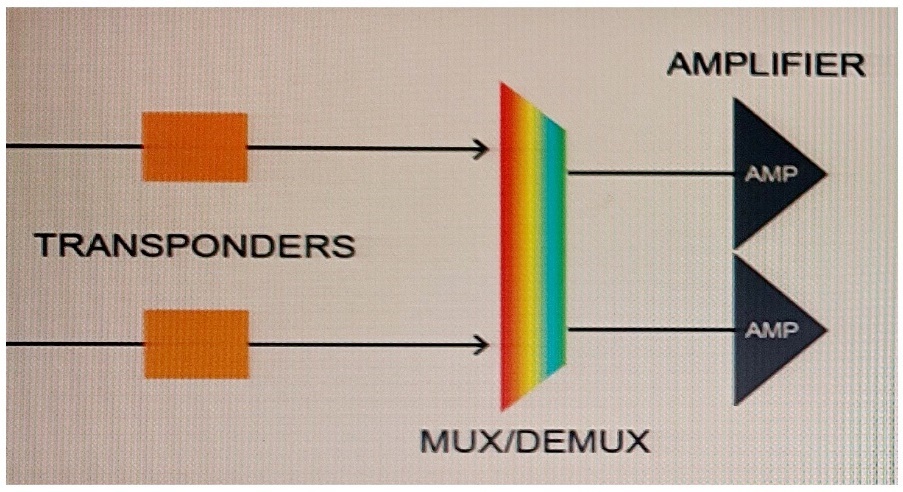
Where is the OPS card equipped to provide the optical channel protection?
ABetween the transponder and the amplifiers
BBetween the filters and the amplifiers
CBefore the transponder, on the client side, towards the external device
DBetween the transponder and the filter
What is the purpose of the NFM-T node synchronization?
AThe partial or full node synchronization allows several entitles/items defined at node level to be retrieved into the NFM-T database (upload).
BThe partial or full node synchronization allows several entities/items defined at NFM-T level to be written into the node database (download).
CThe partial or full node synchronization allows several entities/items defined at EPT level to be retrieved into the NFM-T database (upload from design).
DThe partial or full node synchronization allows several entities/items defined at NFM-T level to be exported into an XML file, to be used as input for EPT (download to design).
With reference to the image, where is the OPS card placed to provide the OMSP protection?
AAfter the amplifiers
BBetween the mux/demux and the amplifiers
CBetween the transponders and the mux/demux
DBefore the transponder, on the client side, towards the external device
Which statement is correct about node synchronization?
AFull synchronization retrieves the correlated alarms from me node
BNode synchronization is executed to test the reachability of a node
CNode synchronization is executed to align the time of the node to the time of the NFM-T platform
DFull synchronization retrieves all items from the node (NE parameters, Ports, Alarms, Internal Links, etc)
Question 6
SWDM-based optical network management
0
Question 7
SWDM-based optical network management
Question 8
SWDM-based optical network management
Question 9
SWDM-based optical network management
Question 10
Protection and restoration
Question 11
Basics of network management system
Question 12
Introduction to WDM networks
Question 13
Basics of optical network design
Question 14
Basics of network management system
Question 15
Introduction to WDM networks
Question 16
Protection and restoration
Question 17
Basics of SWDM nodes
Question 18
Basics of network management system
Question 19
SWDM-based optical network management
Question 20
Basics of optical network design
Question 21
Basics of optical network design
Question 22
Introduction to WDM networks
Question 23
Basics of SWDM nodes
Question 24
Basics of SWDM nodes
Question 25
Basics of SWDM nodes
Ask AstroTutor
0
Ask AstroTutor
0
Ask AstroTutor
0
Ask AstroTutor
0
Ask AstroTutor
0
Ask AstroTutor
0
Ask AstroTutor
0
Ad
Want a break from the ads?
Become a Supporter and enjoy a completely ad-free experience, plus unlock Learn Mode, Exam Mode, AstroTutor AI, and more.
Ask AstroTutor
0
Ask AstroTutor
0
Ask AstroTutor
0
Ask AstroTutor
0
Ask AstroTutor
0
Ask AstroTutor
0
Ask AstroTutor
0
Ask AstroTutor
0
Ask AstroTutor
0
Ask AstroTutor
0
Ask AstroTutor
0
Ask AstroTutor
0
How is it possible to check the activation status of GMRE on a node?
AThe GMRE reachability can be tested via ping request from NFM-T
BThe ControlPlane status column on the node list displays the GMRE status for the selected node
CThe GMRE activation status is reported in the supervision state column on the node list
DThe GMRE activation status is reflected on the color of the icon representing the node
How many PM bins can be stored, for each data collection point, on PSS systems?
A120 x 15-min bins, 60 x 1-day bins and 1 raw bin.
B200 x 15-min bins, 90 x 1-day bins and 1 raw bin.
C4 x 15-min bins and 1 x 1-day bin.
D33 x 15-min bins, 8 x 1-day bins and 1 raw bin.
A user needs to retrieve the active alarm list from a network element. Which command should be issued through an 1830 PSS CLI?
Aalm
Bdisplay alarms
Cshow active alarms
Dretrieve alarms
Which of the following statements about Wavelength Tracker monitoring points in CDC-F architecture is TRUE?
AWavelength Tracker monitoring points are settled on ITL mux interfaces and on OTs line interfaces.
BWavelength Tracker monitoring points are settled on IRDMxx line interfaces only.
CWavelength Tracker monitoring points are settled on IRDMxx line interfaces and on CWR CLS interfaces.
DWavelength Tracker monitoring points are settled on IRDMxx and OTs line interfaces.
Which of the following statements best describes the definition of PCT?
AA tool supporting nodes' automatic provisioning on NFM-T.
BA tool to validate internal fiber connectivity on CDC-F 2.0 nodes.
CA tool supporting zero-touch power management on PSS-32 equipment.
DA tool supporting external links autodiscovery on NFM-T.
What is the purpose of the NFM-T deploy menu?
AIt is used to deploy additional shelves to existing SWDM nodes.
BIt is used to import EPT files to deploy the network based on the EPT design.
CIt is used to deploy new operators (administrator, observers, and so on) to access the platform.
DIt is used to create new network instances, such as physical connections, infrastructures and services.
Which of the following statements is true?
ALogs report both active and historical events.
BAlarms and conditions report a real time status of the node.
CAlarms and conditions report only historical status of the node.
DLogs report a real time status of the node.
Where can the user set the long-haul WT decoder parameter, when designing a network with EPT?
AIn the network parameters
BIn the optimization parameters
CIn the NE parameters
DIn the audit menu
Which sentence about NFM-T is correct?
ANFM-T fully supports L0, L1, L2 and GMPLS applications and it is mainly focused on 1830 PSS, as well as other older product families
BNFM-T fully supports optical and IP nodes
CNFM-T is used to design and manage optical networks
DNFM-T is used to provision optical services having IP nodes as extremities
What is the meaning of first, second, and third window in the optical fiber propagation context?
AThese windows correspond to three different minimum and maximum optical power levels used for optical transmission.
BThese windows are three different wavelength intervals where the WDM optical transmission occurs.
CThese three windows are three different angles of incidence of the light injected by the laser into the fiber.
DDifferent optical transmission windows correspond to different safety requirements and rules for the related lasers operating with these windows.
Which of the following is an example of optical protection mechanism?