Loading provider exams...
Know a question that should be here? Contribute to this exam
Loading provider exams...
You create a page whose PageType property is set to RoleCenter.
You move through the page’s different sections.
You need to add functionality to the page.
What should you do?
A company uses Business Central.
The company plans to use a translation file in an extension. The extension includes a caption that must not be translated.
You need to prevent translation of the caption.
What should you do?
A company uses Business Central.
You plan to assist users with the installation process by using Assisted Setup.
You need to create a wizard page.
Which two actions should you take? Each correct answer provides a complete solution.
NOTE: Each correct selection is worth one point.
You plan to run a debug session for a client.
You extend the Standard Sales - Invoice report to meet a new requirement.
You create a Report Extension, Ext Standard Sales - Invoice, with ID = 50100 and add the following code. (Line numbers are included only for reference.)
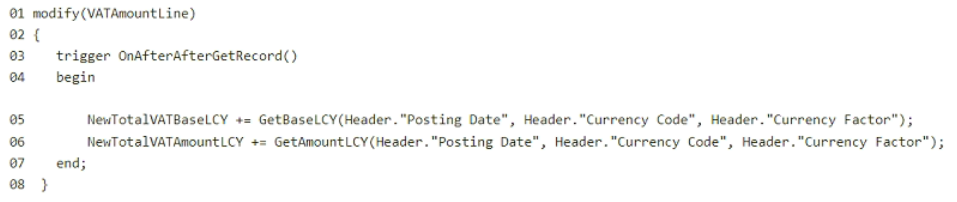
The client reports that the value in the NewTotalVATBaseLCY column is incorrect.
You need to debug the issue to identify its cause.
Which four actions should you carry out, in sequence?
You are developing a test application to test the posting process of a sales order.
You must provide the following implementation:
You need to complete development of the test codeunit. Which methods should you use? You may use each method once, more than once, or not at all.
Fabrikam Inc. is a medium-sized company that plans to implement Dynamics 365 Business Central as an ERP system. The company has a development department that will help with the ERP implementation.
Most employees work remotely from different countries or regions and speak different languages. The various locations and languages cause issues with the current on-premises software.
Fabrikam Inc. plans to implement new and modern software to manage the company. The company wants to use Business Central because it is cloud-based and meets all company requirements.
The company intends to improve reporting and integration functionality by using modern tools such as Power BI and APIs. To reduce the amount of information sent by email, the company plans to expose vendor information to be consumed from external users.
The development department installed Visual Studio Code to create Business Central extensions so the ERP system could be customized according to company needs. All extensions must be developed for the Business Central 2024 wave 1 online version.
The development department plans to use telemetry to control the appropriate use of each new development and works directly in licensed sandbox environments supplied by Microsoft.
The following departments at Fabrikam Inc. have multiple requirements:
The development department designed an extension for the purchase department. Because the developers plan to work with telemetry for monitoring operations, they need the Application Insights information. To accomplish this, the department must add a setting in the corresponding file.
The quality department does not want to receive any warning about the Application Insights setting when the extension is compiled.
The control department requires customizations to Business Central by using a per-tenant extension (PTE) named Subcontract Docs. The PTE includes a table named Subcontract Documents. The table has the following fields:
The extension must be in English - United States (ENU) and Spanish Traditional Sort (ESP) so the application can be used in both languages. The translations must be on the table, not on the page, to avoid repeating them. The control department does not want to use translation files.
The control department manager requires a brief guide for the Description and Comments fields when employees create a new record so users know what to include in the fields. The guide must disappear as soon as users add a value in the fields.
The Subcontract Documents table must be displayed on a new page named Subcontract Document List through an action from the standard Vendor page.
The Amount field, included in the Subcontract Document List, must be formatted in bold format when the record is posted (field Posted = true).
The control department also requires a report to display a list of subcontract documents named Subcontract Documents Excel List. The report must meet the following requirements:
The accounting department plans to use Power BI to analyze information generated by the control department. The accounting department plans to expose an API named API Customer Lines. To improve the performance, the API must use read-only information and work with a Query object to summarize the data.
You have the following code:
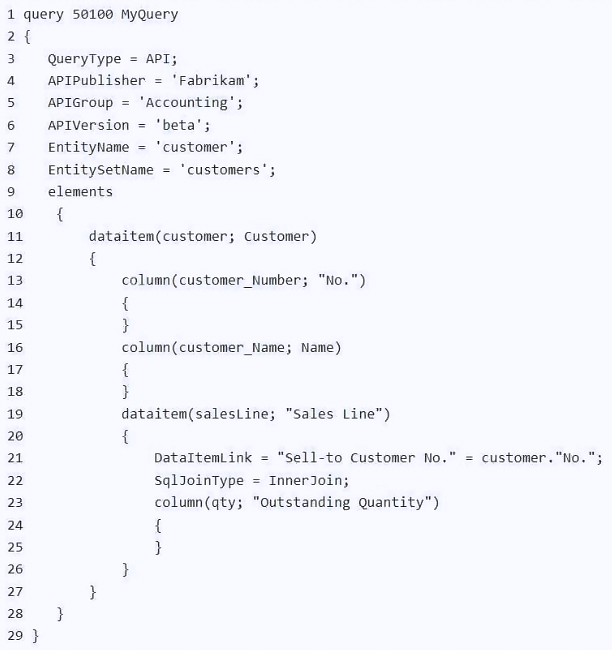
The accounting department must expose data such as the following:

The qty column must be the sum of the Outstanding quantity field of Sales Order Lines. It must be in descending order by quantity.
The department also exposes a page named Fabrikam Vendor API that includes vendor information from the Vendor table, such as number and name. The API must use the replica database to improve performance.
Because Fabrikam Inc. is based in multiple countries and regions, the company periodically must send accounting movements between two dates to the local tax offices named Fabrikam Accounting.
The format for this file must be an XML file generated by an XMLport object. For security reasons, it is not possible to receive data from this XMLport.
The generated XML file must have a schema like this:
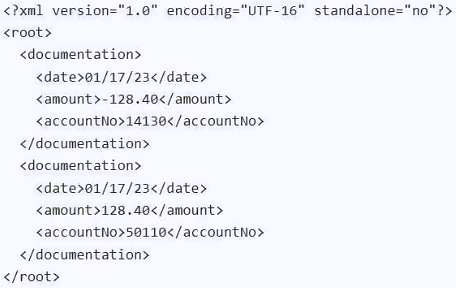
The quality department requires that every new app or extension is designed to meet standard company guidelines. The quality department plans to follow the standard Business Central data model. The quality development must be able to use triggers correctly.
The department must ensure that when a vendor is deleted, the system also removes each record in the Subcontract Documents table related to the vendor. If the subcontract document record has the field Posted = false, it must not be possible to delete the record.
The department has a version 1.0.0.1 installed for an extension named Quality Control. The department develops a new version 1.0.0.2 and uses a codeunit with the subtype Upgrade to update it. The department requires the values for AppVersion and DataVersion on the trigger OnUpgradePerCompany after using NavApp.GetCurrentModuleInfo(myinfo).
You need to modify the API Customer List code to achieve the required result.
For each of the following statements, select Yes if the statement is true. Otherwise, select No.
| Yes | No | Statements |
|---|---|---|
| Add two lines, one between lines 8 and 9 with OrderBy = descending("Outstanding Quantity"); and another between lines 24 and 25 with Method = Sum;. | ||
| Add three lines: one between line 8 and 9 with OrderBy = descending(qty);, another between lines 22 and 23 with DataItemTableFilter = "Document Type" = filter( 'Order');, and another between lines 24 and 25 with Method = Sum;. | ||
| Add three lines: one between lines 8 and 9 with OrderBy = descending(qty);, another between lines 22 and 23 with DataItemTableFilter = "Document Type" = const('Order');, and another between lines 24 and 25 with Method = Sum;. |
Fabrikam Inc. is a medium-sized company that plans to implement Dynamics 365 Business Central as an ERP system. The company has a development department that will help with the ERP implementation.
Most employees work remotely from different countries or regions and speak different languages. The various locations and languages cause issues with the current on-premises software.
Fabrikam Inc. plans to implement new and modern software to manage the company. The company wants to use Business Central because it is cloud-based and meets all company requirements.
The company intends to improve reporting and integration functionality by using modern tools such as Power BI and APIs. To reduce the amount of information sent by email, the company plans to expose vendor information to be consumed from external users.
The development department installed Visual Studio Code to create Business Central extensions so the ERP system could be customized according to company needs. All extensions must be developed for the Business Central 2024 wave 1 online version.
The development department plans to use telemetry to control the appropriate use of each new development and works directly in licensed sandbox environments supplied by Microsoft.
The following departments at Fabrikam Inc. have multiple requirements:
The development department designed an extension for the purchase department. Because the developers plan to work with telemetry for monitoring operations, they need the Application Insights information. To accomplish this, the department must add a setting in the corresponding file.
The quality department does not want to receive any warning about the Application Insights setting when the extension is compiled.
The control department requires customizations to Business Central by using a per-tenant extension (PTE) named Subcontract Docs. The PTE includes a table named Subcontract Documents. The table has the following fields:
The extension must be in English - United States (ENU) and Spanish Traditional Sort (ESP) so the application can be used in both languages. The translations must be on the table, not on the page, to avoid repeating them. The control department does not want to use translation files.
The control department manager requires a brief guide for the Description and Comments fields when employees create a new record so users know what to include in the fields. The guide must disappear as soon as users add a value in the fields.
The Subcontract Documents table must be displayed on a new page named Subcontract Document List through an action from the standard Vendor page.
The Amount field, included in the Subcontract Document List, must be formatted in bold format when the record is posted (field Posted = true).
The control department also requires a report to display a list of subcontract documents named Subcontract Documents Excel List. The report must meet the following requirements:
The accounting department plans to use Power BI to analyze information generated by the control department. The accounting department plans to expose an API named API Customer Lines. To improve the performance, the API must use read-only information and work with a Query object to summarize the data.
You have the following code:
The accounting department must expose data such as the following:
The qty column must be the sum of the Outstanding quantity field of Sales Order Lines. It must be in descending order by quantity.
The department also exposes a page named Fabrikam Vendor API that includes vendor information from the Vendor table, such as number and name. The API must use the replica database to improve performance.
Because Fabrikam Inc. is based in multiple countries and regions, the company periodically must send accounting movements between two dates to the local tax offices named Fabrikam Accounting.
The format for this file must be an XML file generated by an XMLport object. For security reasons, it is not possible to receive data from this XMLport.
The generated XML file must have a schema like this:
The quality department requires that every new app or extension is designed to meet standard company guidelines. The quality department plans to follow the standard Business Central data model. The quality development must be able to use triggers correctly.
The department must ensure that when a vendor is deleted, the system also removes each record in the Subcontract Documents table related to the vendor. If the subcontract document record has the field Posted = false, it must not be possible to delete the record.
The department has a version 1.0.0.1 installed for an extension named Quality Control. The department develops a new version 1.0.0.2 and uses a codeunit with the subtype Upgrade to update it. The department requires the values for AppVersion and DataVersion on the trigger OnUpgradePerCompany after using NavApp.GetCurrentModuleInfo(myinfo).
Fabrikam Inc. is a medium-sized company that plans to implement Dynamics 365 Business Central as an ERP system. The company has a development department that will help with the ERP implementation.
Most employees work remotely from different countries or regions and speak different languages. The various locations and languages cause issues with the current on-premises software.
Fabrikam Inc. plans to implement new and modern software to manage the company. The company wants to use Business Central because it is cloud-based and meets all company requirements.
The company intends to improve reporting and integration functionality by using modern tools such as Power BI and APIs. To reduce the amount of information sent by email, the company plans to expose vendor information to be consumed from external users.
The development department installed Visual Studio Code to create Business Central extensions so the ERP system could be customized according to company needs. All extensions must be developed for the Business Central 2024 wave 1 online version.
The development department plans to use telemetry to control the appropriate use of each new development and works directly in licensed sandbox environments supplied by Microsoft.
The following departments at Fabrikam Inc. have multiple requirements:
The development department designed an extension for the purchase department. Because the developers plan to work with telemetry for monitoring operations, they need the Application Insights information. To accomplish this, the department must add a setting in the corresponding file.
The quality department does not want to receive any warning about the Application Insights setting when the extension is compiled.
The control department requires customizations to Business Central by using a per-tenant extension (PTE) named Subcontract Docs. The PTE includes a table named Subcontract Documents. The table has the following fields:
The extension must be in English - United States (ENU) and Spanish Traditional Sort (ESP) so the application can be used in both languages. The translations must be on the table, not on the page, to avoid repeating them. The control department does not want to use translation files.
The control department manager requires a brief guide for the Description and Comments fields when employees create a new record so users know what to include in the fields. The guide must disappear as soon as users add a value in the fields.
The Subcontract Documents table must be displayed on a new page named Subcontract Document List through an action from the standard Vendor page.
The Amount field, included in the Subcontract Document List, must be formatted in bold format when the record is posted (field Posted = true).
The control department also requires a report to display a list of subcontract documents named Subcontract Documents Excel List. The report must meet the following requirements:
The accounting department plans to use Power BI to analyze information generated by the control department. The accounting department plans to expose an API named API Customer Lines. To improve the performance, the API must use read-only information and work with a Query object to summarize the data.
You have the following code:
The accounting department must expose data such as the following:
The qty column must be the sum of the Outstanding quantity field of Sales Order Lines. It must be in descending order by quantity.
The department also exposes a page named Fabrikam Vendor API that includes vendor information from the Vendor table, such as number and name. The API must use the replica database to improve performance.
Because Fabrikam Inc. is based in multiple countries and regions, the company periodically must send accounting movements between two dates to the local tax offices named Fabrikam Accounting.
The format for this file must be an XML file generated by an XMLport object. For security reasons, it is not possible to receive data from this XMLport.
The generated XML file must have a schema like this:
The quality department requires that every new app or extension is designed to meet standard company guidelines. The quality department plans to follow the standard Business Central data model. The quality development must be able to use triggers correctly.
The department must ensure that when a vendor is deleted, the system also removes each record in the Subcontract Documents table related to the vendor. If the subcontract document record has the field Posted = false, it must not be possible to delete the record.
The department has a version 1.0.0.1 installed for an extension named Quality Control. The department develops a new version 1.0.0.2 and uses a codeunit with the subtype Upgrade to update it. The department requires the values for AppVersion and DataVersion on the trigger OnUpgradePerCompany after using NavApp.GetCurrentModuleInfo(myinfo).
Fabrikam Inc. is a medium-sized company that plans to implement Dynamics 365 Business Central as an ERP system. The company has a development department that will help with the ERP implementation.
Most employees work remotely from different countries or regions and speak different languages. The various locations and languages cause issues with the current on-premises software.
Fabrikam Inc. plans to implement new and modern software to manage the company. The company wants to use Business Central because it is cloud-based and meets all company requirements.
The company intends to improve reporting and integration functionality by using modern tools such as Power BI and APIs. To reduce the amount of information sent by email, the company plans to expose vendor information to be consumed from external users.
The development department installed Visual Studio Code to create Business Central extensions so the ERP system could be customized according to company needs. All extensions must be developed for the Business Central 2024 wave 1 online version.
The development department plans to use telemetry to control the appropriate use of each new development and works directly in licensed sandbox environments supplied by Microsoft.
The following departments at Fabrikam Inc. have multiple requirements:
The development department designed an extension for the purchase department. Because the developers plan to work with telemetry for monitoring operations, they need the Application Insights information. To accomplish this, the department must add a setting in the corresponding file.
The quality department does not want to receive any warning about the Application Insights setting when the extension is compiled.
The control department requires customizations to Business Central by using a per-tenant extension (PTE) named Subcontract Docs. The PTE includes a table named Subcontract Documents. The table has the following fields:
The extension must be in English - United States (ENU) and Spanish Traditional Sort (ESP) so the application can be used in both languages. The translations must be on the table, not on the page, to avoid repeating them. The control department does not want to use translation files.
The control department manager requires a brief guide for the Description and Comments fields when employees create a new record so users know what to include in the fields. The guide must disappear as soon as users add a value in the fields.
The Subcontract Documents table must be displayed on a new page named Subcontract Document List through an action from the standard Vendor page.
The Amount field, included in the Subcontract Document List, must be formatted in bold format when the record is posted (field Posted = true).
The control department also requires a report to display a list of subcontract documents named Subcontract Documents Excel List. The report must meet the following requirements:
The accounting department plans to use Power BI to analyze information generated by the control department. The accounting department plans to expose an API named API Customer Lines. To improve the performance, the API must use read-only information and work with a Query object to summarize the data.
You have the following code:
The accounting department must expose data such as the following:
The qty column must be the sum of the Outstanding quantity field of Sales Order Lines. It must be in descending order by quantity.
The department also exposes a page named Fabrikam Vendor API that includes vendor information from the Vendor table, such as number and name. The API must use the replica database to improve performance.
Because Fabrikam Inc. is based in multiple countries and regions, the company periodically must send accounting movements between two dates to the local tax offices named Fabrikam Accounting.
The format for this file must be an XML file generated by an XMLport object. For security reasons, it is not possible to receive data from this XMLport.
The generated XML file must have a schema like this:
The quality department requires that every new app or extension is designed to meet standard company guidelines. The quality department plans to follow the standard Business Central data model. The quality development must be able to use triggers correctly.
The department must ensure that when a vendor is deleted, the system also removes each record in the Subcontract Documents table related to the vendor. If the subcontract document record has the field Posted = false, it must not be possible to delete the record.
The department has a version 1.0.0.1 installed for an extension named Quality Control. The department develops a new version 1.0.0.2 and uses a codeunit with the subtype Upgrade to update it. The department requires the values for AppVersion and DataVersion on the trigger OnUpgradePerCompany after using NavApp.GetCurrentModuleInfo(myinfo).
Fabrikam Inc. is a medium-sized company that plans to implement Dynamics 365 Business Central as an ERP system. The company has a development department that will help with the ERP implementation.
Most employees work remotely from different countries or regions and speak different languages. The various locations and languages cause issues with the current on-premises software.
Fabrikam Inc. plans to implement new and modern software to manage the company. The company wants to use Business Central because it is cloud-based and meets all company requirements.
The company intends to improve reporting and integration functionality by using modern tools such as Power BI and APIs. To reduce the amount of information sent by email, the company plans to expose vendor information to be consumed from external users.
The development department installed Visual Studio Code to create Business Central extensions so the ERP system could be customized according to company needs. All extensions must be developed for the Business Central 2024 wave 1 online version.
The development department plans to use telemetry to control the appropriate use of each new development and works directly in licensed sandbox environments supplied by Microsoft.
The following departments at Fabrikam Inc. have multiple requirements:
The development department designed an extension for the purchase department. Because the developers plan to work with telemetry for monitoring operations, they need the Application Insights information. To accomplish this, the department must add a setting in the corresponding file.
The quality department does not want to receive any warning about the Application Insights setting when the extension is compiled.
The control department requires customizations to Business Central by using a per-tenant extension (PTE) named Subcontract Docs. The PTE includes a table named Subcontract Documents. The table has the following fields:
The extension must be in English - United States (ENU) and Spanish Traditional Sort (ESP) so the application can be used in both languages. The translations must be on the table, not on the page, to avoid repeating them. The control department does not want to use translation files.
The control department manager requires a brief guide for the Description and Comments fields when employees create a new record so users know what to include in the fields. The guide must disappear as soon as users add a value in the fields.
The Subcontract Documents table must be displayed on a new page named Subcontract Document List through an action from the standard Vendor page.
The Amount field, included in the Subcontract Document List, must be formatted in bold format when the record is posted (field Posted = true).
The control department also requires a report to display a list of subcontract documents named Subcontract Documents Excel List. The report must meet the following requirements:
The accounting department plans to use Power BI to analyze information generated by the control department. The accounting department plans to expose an API named API Customer Lines. To improve the performance, the API must use read-only information and work with a Query object to summarize the data.
You have the following code:
The accounting department must expose data such as the following:
The qty column must be the sum of the Outstanding quantity field of Sales Order Lines. It must be in descending order by quantity.
The department also exposes a page named Fabrikam Vendor API that includes vendor information from the Vendor table, such as number and name. The API must use the replica database to improve performance.
Because Fabrikam Inc. is based in multiple countries and regions, the company periodically must send accounting movements between two dates to the local tax offices named Fabrikam Accounting.
The format for this file must be an XML file generated by an XMLport object. For security reasons, it is not possible to receive data from this XMLport.
The generated XML file must have a schema like this:
The quality department requires that every new app or extension is designed to meet standard company guidelines. The quality department plans to follow the standard Business Central data model. The quality development must be able to use triggers correctly.
The department must ensure that when a vendor is deleted, the system also removes each record in the Subcontract Documents table related to the vendor. If the subcontract document record has the field Posted = false, it must not be possible to delete the record.
The department has a version 1.0.0.1 installed for an extension named Quality Control. The department develops a new version 1.0.0.2 and uses a codeunit with the subtype Upgrade to update it. The department requires the values for AppVersion and DataVersion on the trigger OnUpgradePerCompany after using NavApp.GetCurrentModuleInfo(myinfo).
Fabrikam Inc. is a medium-sized company that plans to implement Dynamics 365 Business Central as an ERP system. The company has a development department that will help with the ERP implementation.
Most employees work remotely from different countries or regions and speak different languages. The various locations and languages cause issues with the current on-premises software.
Fabrikam Inc. plans to implement new and modern software to manage the company. The company wants to use Business Central because it is cloud-based and meets all company requirements.
The company intends to improve reporting and integration functionality by using modern tools such as Power BI and APIs. To reduce the amount of information sent by email, the company plans to expose vendor information to be consumed from external users.
The development department installed Visual Studio Code to create Business Central extensions so the ERP system could be customized according to company needs. All extensions must be developed for the Business Central 2024 wave 1 online version.
The development department plans to use telemetry to control the appropriate use of each new development and works directly in licensed sandbox environments supplied by Microsoft.
The following departments at Fabrikam Inc. have multiple requirements:
The development department designed an extension for the purchase department. Because the developers plan to work with telemetry for monitoring operations, they need the Application Insights information. To accomplish this, the department must add a setting in the corresponding file.
The quality department does not want to receive any warning about the Application Insights setting when the extension is compiled.
The control department requires customizations to Business Central by using a per-tenant extension (PTE) named Subcontract Docs. The PTE includes a table named Subcontract Documents. The table has the following fields:
The extension must be in English - United States (ENU) and Spanish Traditional Sort (ESP) so the application can be used in both languages. The translations must be on the table, not on the page, to avoid repeating them. The control department does not want to use translation files.
The control department manager requires a brief guide for the Description and Comments fields when employees create a new record so users know what to include in the fields. The guide must disappear as soon as users add a value in the fields.
The Subcontract Documents table must be displayed on a new page named Subcontract Document List through an action from the standard Vendor page.
The Amount field, included in the Subcontract Document List, must be formatted in bold format when the record is posted (field Posted = true).
The control department also requires a report to display a list of subcontract documents named Subcontract Documents Excel List. The report must meet the following requirements:
The accounting department plans to use Power BI to analyze information generated by the control department. The accounting department plans to expose an API named API Customer Lines. To improve the performance, the API must use read-only information and work with a Query object to summarize the data.
You have the following code:
The accounting department must expose data such as the following:
The qty column must be the sum of the Outstanding quantity field of Sales Order Lines. It must be in descending order by quantity.
The department also exposes a page named Fabrikam Vendor API that includes vendor information from the Vendor table, such as number and name. The API must use the replica database to improve performance.
Because Fabrikam Inc. is based in multiple countries and regions, the company periodically must send accounting movements between two dates to the local tax offices named Fabrikam Accounting.
The format for this file must be an XML file generated by an XMLport object. For security reasons, it is not possible to receive data from this XMLport.
The generated XML file must have a schema like this:
The quality department requires that every new app or extension is designed to meet standard company guidelines. The quality department plans to follow the standard Business Central data model. The quality development must be able to use triggers correctly.
The department must ensure that when a vendor is deleted, the system also removes each record in the Subcontract Documents table related to the vendor. If the subcontract document record has the field Posted = false, it must not be possible to delete the record.
The department has a version 1.0.0.1 installed for an extension named Quality Control. The department develops a new version 1.0.0.2 and uses a codeunit with the subtype Upgrade to update it. The department requires the values for AppVersion and DataVersion on the trigger OnUpgradePerCompany after using NavApp.GetCurrentModuleInfo(myinfo).
You create a “Contoso Post” procedure that sends an HTTP POST request in JSON format, then publish it to your environment.
You write the following procedure code:
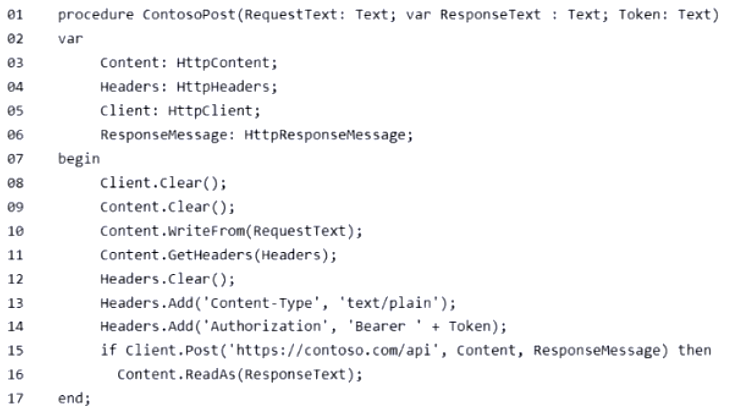
The procedure does not work as intended.
You need to identify and correct every error in the HTTP class usage.
For each of the following statements, select Yes if the statement is true. Otherwise, select No.
| Yes | No | Statements |
|---|---|---|
| Replace line 16 with ResponseText := ResponseMessage | ||
| In line 13, change the 'text/plain' value to 'application/json' | ||
| Replace line 14 with Client.DefaultRequestHeaders.Add('Authorization', 'Bearer ' + Token); | ||
| In line 10, replace WriteFrom with ReadAs |
You are developing a test codeunit for a company that uses Business Central.
The company requires the following options when posting a sales order:
You must create a test codeunit that automatically selects one of these options.
You need to create the test codeunit.
Which handler should you use?
Go ad-free and unlock Learn Mode, Exam Mode, AstroTutor AI and every premium tool — everything you need to walk in prepared, and confident.
HOTSPOT -
You create a query that includes a procedure to display the top customers. The procedure fails at run time.
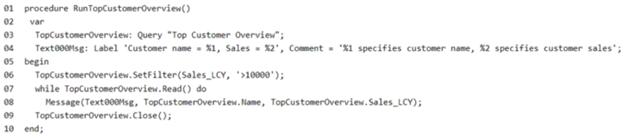
You need to fix the code.
For each of the following statements, select Yes if the statement is true. Otherwise, select No.
| Yes | No | Statements |
|---|---|---|
| Enclose line 08 into BEGIN.. END. | ||
| Add TopCustomerOverview.Open(); before TopCustomerOverview.SetFilter(Sales_LCY, '>10000'); in line 06. | ||
| Add TopCustomerOverview.Open(); after TopCustomerOverview.SetFilter(Sales_LCY, '>10000'); in line 06. | ||
| Replace SetFilter in line 06 with SetRange. |
A company uses four objects during Business Central development.
The company plans to modify the objects. Identify the application layer for each object in Visual Studio Code.
Each application layer may be used once, more than once, or not at all.
You develop an extension for the latest release of Business Central online.
A customer uses an earlier on-premises release of Business Central, and the extension must be deployed to that customer's environment.
You need to deploy the extension to the earlier Business Central version.
What should you do?
A company is implementing Business Central.
The company has these report requirements:
You need to implement these requirements. Each trigger may be used once, more than once, or not at all.
You have a column in a report.
You receive the following CodeCop warning:
> “Field ‘Home Page’ is marked for removal. Reason: Field length will be increased to 255. AL(AL0432)”
You have this code:
column(CompanyHomePage; CompanyInformation."Home Page")
\{
\}
For each of the following statements, select Yes if the statement is true. Otherwise, select No.
| Yes | No | Statements |
|---|---|---|
| Create a custom Home Page field for the Company information table. | ||
| Enclose Line 1 within #pragma warning disable AL0432 .. #pragma warning restore AL0432. | ||
| Disable the AL0432 rule in the ruleset. | ||
| Remove or comment the column and then put it back after the field length is increased. |
A company intends to set up a local Business Central Development Docker container.
The environment will be used to test new project ideas.
You need to ensure that the latest Business Central artifact URL is selected. Which command should you use?
A company is configuring a sandbox environment.
The following Visual Studio Code issues are observed:
Identify the solution for each issue.
You are creating an app for Business Central.
You plan to specify the following parameters and properties of the server and app:
You need to configure the JSON file for the specified parameters and properties.
Move the appropriate files to the correct object purposes. Each file can be used once, more than once, or not at all.
HOTSPOT -
You have a per-tenant extension containing the following code.
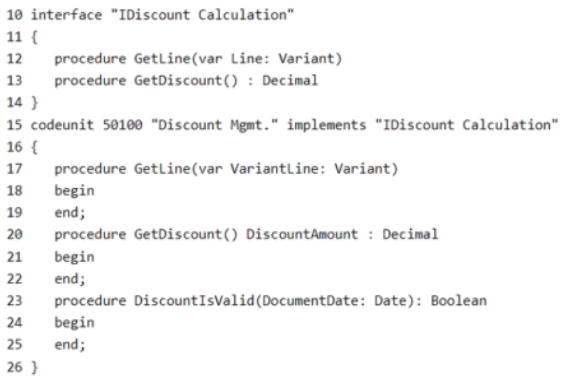
For each of the following statements, select Yes if the statement is true. Otherwise, select No.
| Yes | No | Statements |
|---|---|---|
| Codeunit "Discount Mgmt." compiles successfully. | ||
| VariantLine in line 17 must be changed to Line and the DiscountAmount removed for the codeunit to compile. | ||
| The DiscountIsValid method must be defined in the interface for the code to compile. |
You create a page whose PageType property is set to RoleCenter.
You move through the page’s various sections.
You need to add functionality to the page.
What should you do?
A company uses Business Central.
The company plans to use the AL object model in Business Central to extend the Base Application.
You need to extend the objects.
Which two objects can be extended? Each correct answer provides a complete solution.
NOTE: Each correct selection is worth one point.
You need to use a query data type to retrieve the required data.
How should you complete the code?
if QueryA.() then begin while QueryA.() do begin end; end;
You must add a property to the Description and Comments fields with the corresponding values for the control department manager.
Which property should you add?
You need to set the XML file properties for the accounting department.
How should you complete the code segment?
xmlport 50100 "Fabrikam Accounting" { Caption = 'Fabrikam Accounting'; UseRequestPage = true; schema { textelement(root) { tableelement(documentation; ) { fieldelement(date; documentation."Posting Date") { } } } } }
Assist the development department in configuring Visual Studio Code to create the purchase department extension while satisfying the quality department requirements.
How should the app.json file be completed?
{ ------ "": "InstrumentationKey=243d2dc8-60e2....", "target": , "runtime": "13.0", ------ }
You must create the Fabrikam Vendor API for the accounting department.
How should the code segment be completed?
{ Caption = 'Fabrikam Vendor API'; APIPublisher = 'fabrikam'; APIGroup = 'control'; APIVersion = 'v2.0'; EntityName = 'vendor'; EntitySetName = 'vendors'; SourceTable = Vendor; Editable = false; layout { area(Content) { repeater(GroupName) { field(vendorNo; Rec."No.") { Caption = 'vendorNo'; } field(vendorName; Rec.Name) { Caption = 'Name'; } } } } }
You need to modify the code to satisfy the Control department’s formatting requirements for the Subcontract Document List.
Which formatting should you use?

Community Discussion