Design and implement core networking infrastructureDesign, implement, and manage connectivity servicesDesign and implement application delivery servicesDesign and implement private access to Azure servicesDesign and implement Azure network security services
You have an Azure subscription linked to an Azure Active Directory (Azure AD) tenant named contoso.onmicrosoft.com. The subscription contains these resources:
A virtual network named Vnet1
An App Service plan named ASP1
An Azure App Service named webapp1
An Azure private DNS zone named private.contoso.com
Virtual machines on Vnet1 that cannot communicate outside the virtual network
You need to ensure that the virtual machines on Vnet1 can access webapp1 by using the URL https://www.private.contoso.com.
Which two actions should you take? Each correct answer is part of the solution.
NOTE: Each correct selection is worth one point.
Choose two
ACreate a CNAME record that maps www.private.contoso.com to webapp1.contoso.onmicrosoft.com.
BCreate a CNAME record that maps www.private.contoso.com to webapp1.private.contoso.com.
CCreate a service endpoint for webapp1.
DRegister an enterprise application in Azure AD for webapp1.
ECreate a private endpoint for webapp1.
FCreate a CNAME record that maps www.private.contoso.com to webapp1.privatelink.azurewebsites.net.
You have an Azure subscription that contains a virtual network. The virtual network has two subnets named Subnet1 and Subnet2. You have an Azure Application Gateway v2 instance named AppGw1 connected to Subnet1.
You need to move AppGw1 to Subnet2. The solution must minimize downtime.
What should you do?
Select
Set the frontend IP address type to:
Before moving AppGw1, run:
To move AppGw1, run:
Your on-premises network contains a VPN device.
You have an Azure subscription that contains a virtual network and a virtual network gateway.
You need to create a Site-to-Site VPN connection with a custom cryptographic policy.
No comments yet. Be the first to start the discussion!
Save question
0
Community Discussion
No comments yet. Be the first to start the discussion!
Save question
0
Community Discussion
No comments yet. Be the first to start the discussion!
Save question
0
Community Discussion
No comments yet. Be the first to start the discussion!
Save question
0
Community Discussion
No comments yet. Be the first to start the discussion!
Save question
0
Community Discussion
No comments yet. Be the first to start the discussion!
Save question
0
Community Discussion
No comments yet. Be the first to start the discussion!
Save question
0
Community Discussion
No comments yet. Be the first to start the discussion!
Save question
0
Community Discussion
No comments yet. Be the first to start the discussion!
Save question
0
Community Discussion
No comments yet. Be the first to start the discussion!
Save question
0
Community Discussion
No comments yet. Be the first to start the discussion!
Save question
0
Community Discussion
No comments yet. Be the first to start the discussion!
You have an Azure subscription.
You plan to deploy an Azure application gateway named AGW1.
You must implement an external TLS certificate store for AGW1 that meets these requirements:
Store keys with the highest possible security.
Minimize administrative effort.
Which certificate-store type and identity type should be used to access the store?
Select
Certificate store type:
Identity type:
An Azure subscription contains a virtual machine named VM1 and a network security group (NSG) named NSG1. NSG1 has its default rules configured. VM1 runs Windows Server 2022 and has one NIC, named NIC1. NIC1 is associated with NSG1.
You need to block access to the Azure Instance Metadata Service (IMDS) REST API from VM1. The solution must minimize administrative effort.
What should you add to NSG1?
Aan outbound rule that blocks traffic to an IP address.
Ban inbound rule that blocks traffic to an IP address.
Can inbound and outbound rule that blocks traffic to an application security group.
Dan outbound rule that blocks traffic to a service tag.
HOTSPOT -
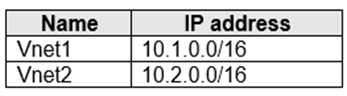
You have an Azure private DNS zone named contoso.com linked to the virtual networks shown in the following table.
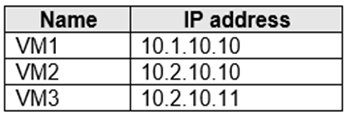
The links have auto-registration enabled. You create the virtual machines shown in the following table.
You manually add the following entry to the contoso.com zone:
✑ Name: VM1
IP address: 10.1.10.9 -
For each of the following statements, select Yes if the statement is true. Otherwise, select No.
Yes or No
Yes
No
Statements
VM2 will resolve vm1.contoso.com to 10.1.10.10
Deleting VM1 will delete all VM1 records automatically
Changing the IP address of VM3 will update the DNS record of VM3 automatically
HOTSPOT -
You have an Azure subscription containing 10 virtual machines. The virtual machines have private IP addresses. The subscription includes the resources shown in the following table.
You need to configure FWPolicy1 to meet these requirements:
Allow inbound internet connections to the virtual machines on port 4567.
Block outbound connections from the virtual machines to an FQDN of *.fabrikam.com.
What should you configure in FWPolicy1?
Select
To allow inbound connections:
To block outbound connections:
You have an on-premises network.
Your Azure subscription contains a virtual network named VNet1. VNet1 is connected to an Azure Virtual WAN hub named Hub1.
You need to enable connectivity between the on-premises network and VNet1 by using Hub1.
Which three actions should you perform, in sequence?
Drag & Drop
Create a VPN site.
Create a User VPN configuration.
Connect the VPN site to Hub2.
Connect the VPN site to Hub1.
Configure a Site-to-Site (S2S) VPN gateway.
Create a virtual WAN hub named Hub2.
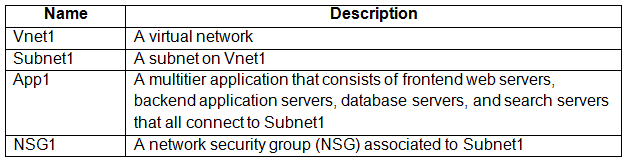
You purchase an Azure subscription and plan to deploy the resources shown in the following table to that subscription.
You need to create an NSG1 rule named Rule1 that meets these requirements:
Allow the search servers of App1 to establish outbound HTTP connections to internet services.
Minimize administrative effort when new search servers are deployed.
Apply the principle of least privilege.
What should you choose as the source for Rule1?
AApplication security group
BIP Addresses
CAny
DVirtualNetwork
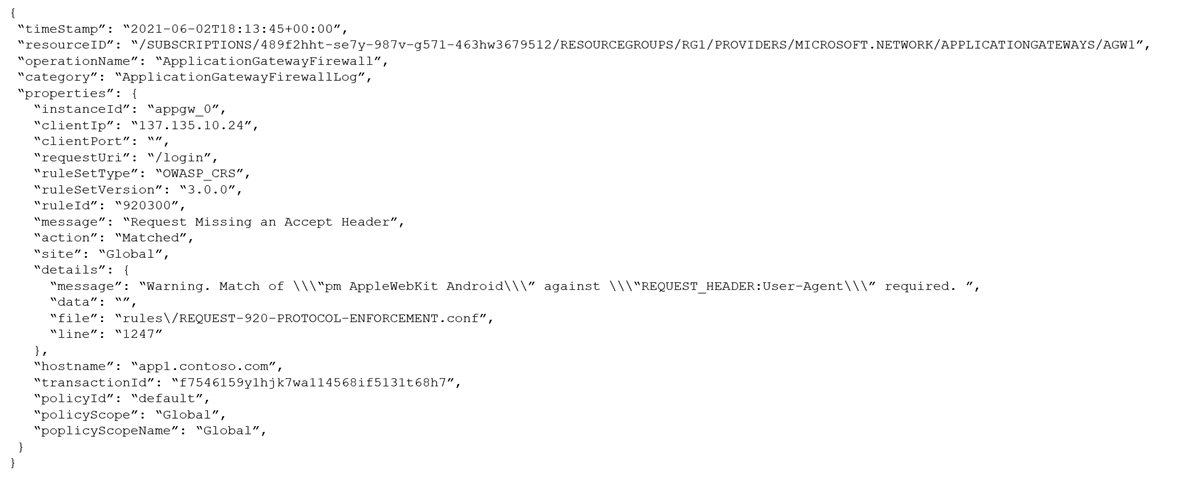
Solution: Disable the WAF rule with ruleId 920300.
Does this meet the goal?
AYes
BNo
You have an Azure subscription that contains a virtual network named Vnet1 and an Azure SQL database named SQL1. SQL1 has a private endpoint on Vnet1.
You have a partner company named Fabrikam, Inc. Fabrikam has an Azure subscription that contains a virtual network named Vnet2 and a virtual machine named VM1. VM1 is connected to Vnet2.
You need to give VM1 access to SQL1 by using an Azure Private Link service.
What should you implement on each virtual network? Each resource may be used once, more than once, or not at all.
Drag & Drop
A NAT gateway
A peering link
A private endpoint
A service endpoint
An Azure application gateway
An Azure load balancer
Vnet1:
Vnet2:
You are designing the IP address space for subnets in Azure virtual networks.
Which resource type needs IP addresses within the subnets?
Ainternal load balancers
BAzure DDoS Protection for virtual networks
Cservice endpoint policies
Dservice endpoints
You have an Azure subscription containing a virtual network named Vnet1. Vnet1 includes 20 subnets and 500 virtual machines. Every subnet contains a virtual machine that runs network monitoring software.
A network security group (NSG) named NSG1 is associated with each subnet.
When a new subnet is created in Vnet1, an automated process creates an additional network-monitoring virtual machine in that subnet and associates the subnet with NSG1.
You need to create an inbound security rule in NSG1 that allows connections to the network-monitoring virtual machines from the IP address 131.107.1.15. The solution must meet the following requirements:
Ensure that only the monitoring virtual machines receive a connection from 131.1071.15.
Minimize changes to NSG1 when a new subnet is created.
What should you use as the destination in the inbound security rule?
Aan application security group
Ba service tag
Ca virtual network
Dan IP address
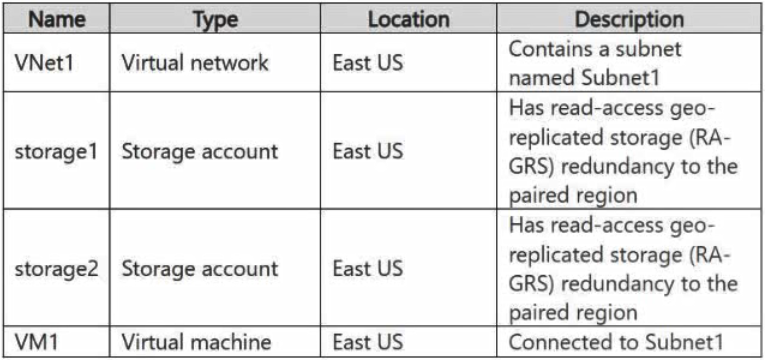
You have an Azure subscription containing the resources shown in the following table.
You create a service endpoint policy with these settings:
Associated subnets: Subnet1
Service: Microsoft.Storage
Scope: Single account
Resource: storage1
Which resources can VM1 access?
Astorage1 in the East US Azure region and its replica in the paired region
Bstorage1 in the East US Azure region only
Cstorage1 and storage2 in the East US Azure region only
Dstorage1 and storage2 in the East US Azure region and their replicas in the paired region
You are planning an Azure deployment that will include three virtual networks in the East US Azure region, as shown in the following table.
A Site-to-Site VPN will connect Vnet1 to your company's on-premises network.
You need to recommend a solution that ensures the virtual machines on every virtual network can communicate with the on-premises network. The solution must minimize costs.
What should you recommend for Vnet2 and Vnet3?
AVNet-to-VNet VPN connections
Bpeering
Cservice endpoints
Droute tables
You intend to configure BGP for a Site-to-Site VPN connection between a datacenter and Azure.
Which two Azure resources must you configure? Each correct answer represents part of the solution.
NOTE: Each correct selection is worth one point.
Choose two
Aa virtual network gateway
BAzure Application Gateway
CAzure Firewall
Da local network gateway
EAzure Front Door
You have two Azure subscriptions, named Sub1 and Sub2, that contain the resources shown in the following table.
You need to make sure that App1 can access Resource1 by using the Azure Private Link service.
Which resource should you deploy to each virtual network to satisfy the Private Link service prerequisites?
Select
Vnet1:
Vnet2:
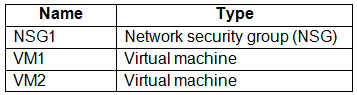
Which virtual machines can VM1 and VM4 ping successfully?
Select
VM1:
VM4:
You have an Azure subscription containing the resources shown in the following table.
NSG1 is linked to the NIC for VM1 and includes the rules shown in the following table.
You collect NSG flow logs for five minutes for these activities:
Two RDP sessions from VM1 to VM2, each started from a different TCP port
Three SSH sessions from VM2 to VM1, each started from a different TCP port
You analyze the logs by using Traffic Analytics in Azure Network Watcher.
How many aggregated flow entries will Traffic Analytics identify?
A1
B2
C5
D10
You need to deploy a P2S VPN for the branch-office users. The solution must satisfy the hybrid networking requirements.
What should you do?
Select
On the VPN gateway in Vnet1, set the P2S VPN tunnel type to:
In the litwareinc.com tenant:
You have an Azure subscription.
You must create an Azure application gateway named AGW1 with Azure Web Application Firewall (WAF) enabled. The solution must ensure that WAF blocks every request to AGW1 from an IP address in the 100.64.0.0/24 range.
Which five PowerShell cmdlets should be run, in order?
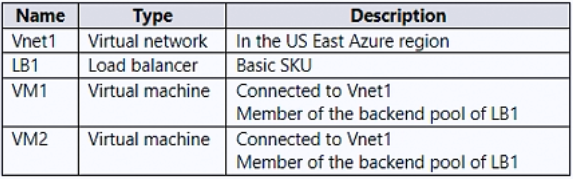
You plan to deploy an Azure virtual network containing 10 virtual subnets. The subnets will use IPv6 addresses. Each subnet will host up to 200 load-balanced virtual machines.
You need to recommend a load-balancing solution for the virtual network. The solution must meet these requirements:
The virtual machines and the load balancer must be accessible only from within the virtual network.
Costs must be minimized.
What should you include in the recommendation?
ABasic Azure Load Balancer
BAzure Application Gateway v1
CAzure Standard Load Balancer
DAzure Application Gateway v2
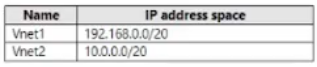
You have two Azure virtual networks in the East US Azure region, as shown in the following table.
The virtual networks are peered with each other. Each virtual network has four subnets.
You plan to deploy a virtual machine named VM1 to inspect and route traffic among all subnets across both virtual networks.
What is the minimum number of IP addresses that you must assign to VM1?







Community Discussion