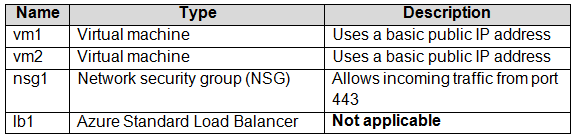
lb1 is a Standard load balancer, and vm1 and vm2 have Basic SKU public IP addresses. VMs in a backend pool don't need a public IP address, but if they have one, the SKUs of the load balancer and the public IP addresses must match: you can't mix Basic and Standard SKU resources, and a standalone VM can't reference both SKUs at the same time. So the VMs can't join lb1's backend pool while they keep their Basic public IPs. Basic SKU public IPs were retired on September 30, 2025; existing ones still run but are unsupported, and upgrading them to Standard SKU also starts with detaching them from the VMs.
Step 1: remove (dissociate) the Basic public IP addresses from vm1 and vm2. Step 2: on lb1, create a backend pool that contains vm1 and vm2, and a health probe for the HTTPS workload (HTTPS or TCP port 443). Step 3: create a load-balancing rule that maps the frontend on port 443 to the backend pool and uses that probe; the rule references both the pool and the probe, so they must exist first.
Don't remove nsg1: Standard Load Balancer is secure by default and is closed to inbound flows unless a network security group allows them, and nsg1 already allows port 443. An availability set isn't needed, because a Standard load balancer's backend pool can contain any virtual machines in a single virtual network; the single-availability-set requirement applied only to the retired Basic SKU.
Community Discussion