About the Exam

This written Juniper certification exam is for networking professionals pursuing the JNCIP-SP credential. It covers advanced Junos OS routing and switching topics including OSPF, IS-IS, BGP, CoS, IP multicast, Layer 3 VPNs, Layer 2 VPNs, VPLS, and EVPN. Passing demonstrates advanced knowledge of routing technologies, platform configuration, and troubleshooting skills for Juniper service provider networks.

Exam Topics

  • OSPF0%
  • IS-IS0%
  • BGP0%
  • Class of Service (CoS)0%
  • IP Multicast0%
  • Layer 3 VPNs0%
  • Layer 2 VPNs0%

How to Use This Practice Exam

  1. Browse — Read each question, select your answer, and reveal the explanation.
  2. Exam Mode — Simulate real exam conditions with a timed session and score report.
  3. Learn Mode — Spaced repetition schedules questions you struggle with for long-term retention.

Download the Full Exam PDF

Get every question and answer in a clean, printable PDF built for offline study. Purchase once, keep permanent access, and re-download the latest version anytime.

Last updated July 14, 2026 at 9:51 PM

Topic filter
Retired questions
Question sort

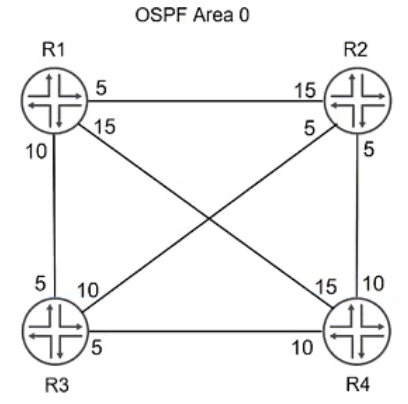
Following a recent power outage, your manager asks you to investigate methods to automatically lessen the effects of suboptimal routing in your OSPF and OSPFv3 network after devices restart.

Which three configuration statements achieve this objective?

Choose three
  • A set protocols ospf3 realm ipv4-unicast overload timeout 900
  • B set protocols ospf overload
  • C set protocols ospf overload timeout 900
  • D set protocols ospf3 overload
  • E set protocols ospf3 overload timeout 900
Explanation

An OSPF overload configuration makes a router appear unavailable for transit traffic while it restarts, steering transit traffic through other routers. Specifying timeout 900 automatically clears overload mode after 900 seconds; without a timeout, overload remains active until it is explicitly removed. The timeout must be configured for OSPF, native OSPFv3, and the OSPFv3 IPv4-unicast realm.

Learn more

Community Discussion

No comments yet. Be the first to start the discussion!

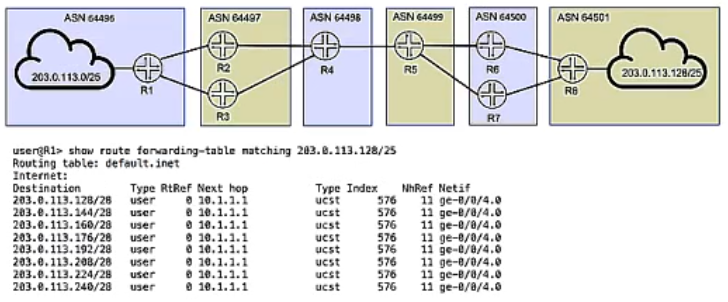
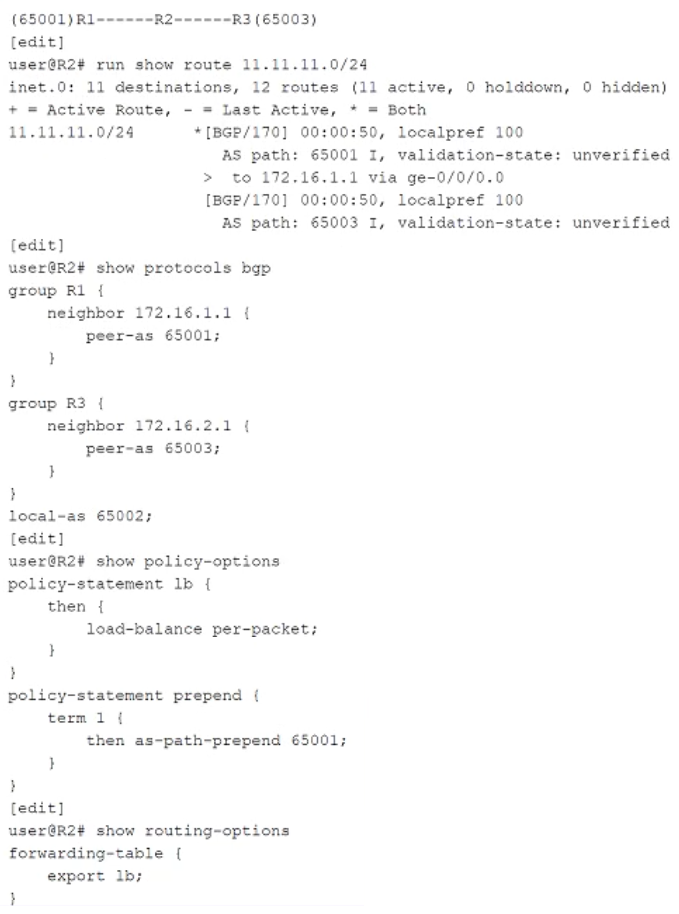
Click the Exhibit button.

Question Image

You are troubleshooting the connection between AS 64496 and AS 64497 and notice that only one path is being used for traffic forwarding.

Referring to the exhibit, which three actions will ensure that R1 is properly configured for BGP-route load balancing?

Choose three
  • A Verify that the routing table on R1 has BGP routes for 203.0.113.128/25 with multiple next hops.
  • B Verify that the multipath option is configured under protocols bgp on both R2 and R3.
  • C Verify that there is a load balancing export policy under routing-options for the received BGP routes on R1.
  • D Verify that the multipath option is configured under protocols bgp on R1.
  • E Verify that an import load balancing policy exists under protocols bgp for the received BGP routes on R1.
Explanation

BGP multipath on R1 allows equal BGP paths learned through R2 and R3 to be retained as multiple next hops. The route for 203.0.113.128/25 must consequently show multiple next hops. A load-balancing policy must also be exported from the routing table to the forwarding table under routing-options so traffic can be distributed across those next hops.

Learn more

Community Discussion

No comments yet. Be the first to start the discussion!

QuestionQ3

Class of Service (CoS)

A packet arrives on an interface configured for transmission scheduling. One configured queue exceeds its allocated bandwidth.

In this scenario, which two actions does a Junos device take by default?

Choose two
  • A The exceeding queue will be considered to have negative bandwidth credit.
  • B The excess traffic will be discarded.
  • C The exceeding queue will be considered to have positive bandwidth credit.
  • D The excess traffic will use bandwidth available from other queues.
Explanation

A queue receiving traffic beyond its configured bandwidth allocation has negative bandwidth credit. By default, Junos permits that queue to use leftover bandwidth available from other queues; strict allocation must be explicitly configured to prevent this behavior.

Learn more

Community Discussion

No comments yet. Be the first to start the discussion!

Which two statements concerning IS-IS are correct?

Choose two
  • A CSNPs are flooded periodically.
  • B PSNPs are flooded periodically.
  • C PSNPs contain only descriptions of LSPs.
  • D CSNPs contain only descriptions of LSPs.
Explanation

CSNPs are transmitted periodically to synchronize link-state databases. PSNPs request missing LSPs or acknowledge received LSPs and carry LSP summary information, such as identifiers, lifetimes, sequence numbers, and checksums, rather than full LSP contents. Juniper IS-IS Overview

Learn more

Community Discussion

No comments yet. Be the first to start the discussion!

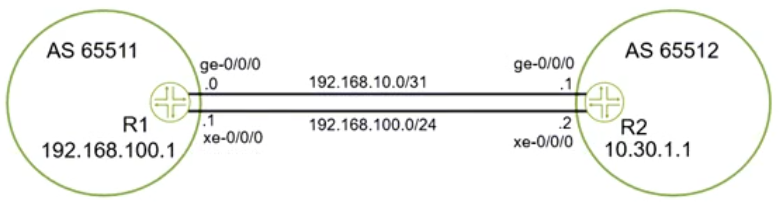
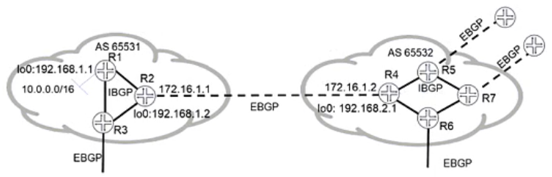
Click the Exhibit button.

Question Image

You must exchange routes between R1 and R4 as shown in the exhibit. These two routers use the same AS number.

Which two steps will accomplish this task?
Choose two
  • A Configure the BGP group with the advertise-peer-as parameter on R2 and R3.
  • B Configure the BGP group with the as-override parameter on R1 and R4.
  • C Configure the BGP group with the advertise-peer-as parameter on R1 and R4.
  • D Configure the BGP group with the as-override parameter on R2 and R3.
Explanation

advertise-peer-as on R2 and R3 overrides Junos’s default suppression of routes learned from one EBGP peer when advertising them to another EBGP peer in the same AS as the originating peer. as-override on R2 and R3 replaces occurrences of the outbound peer’s AS in the AS path with the provider AS, so R1 and R4 can accept routes originating from their shared AS without triggering AS-path loop prevention.

Learn more

Community Discussion

No comments yet. Be the first to start the discussion!
Know a question that should be here? Contribute to this exam
Back home