Which two statements correctly describe how EX Series switches use captive portal for Layer 2 authentication? (Choose two.)
AThe captive portal is the default Layer 2 authentication method that is applied before other methods such as 802.1X or MAC RADIUS.
BThe captive portal authentication allowlist works for devices that do not have HTTP capabilities.
CThe captive portal is configured on Layer 3 interfaces and does not participate in Layer 2 authentication on EX Series switches.
DThe captive portal is used as a fallback mechanism for clients that fail 802.1X or MAC RADIUS authentication.
Your OSPF network consists of a mix of 1GbE and 10GbE interfaces. By default, all interfaces have the same cost in your OSPF network. You are asked to ensure that the 10GbE interfaces are more preferred when available.
In this scenario, which two statements would accomplish this behavior? (Choose two.)
AYou should define the reference bandwidth as 10G, which will assign the 1GbE interfaces a higher cost.
BYou should manually assign the interface metric for each 10GbE interface to be higher than the 1GbE interfaces in your OSPF network.
CYou should define the reference bandwidth as 1G, which will assign the 1GbE interfaces a higher cost.
DYou should manually assign the interface metric for each 1GbE interface to be higher than the 10GbE interfaces in your OSPF network.
You have two multicast receivers connected to the same VLAN. You notice that the switch that they are connected to is forwarding multicast traffic out of all the ports in the same VLAN, instead of just the two ports for the connected multicast receivers.
In this scenario, what would you configure to optimize multicast forwarding?
Apromiscuous mode
Bspanning tree
CIGMP snooping
DIRB interface
You are implementing an EVPN-VXLAN edge-routed bridging design using Layer 3 gateway operations.
In this scenario, which statement is correct?
AEach distribution switch has unique IP addresses for IRB interfaces; routing protocols run on IRB interfaces.
BDistribution switches share the same anycast IP addresses for IRB interfaces; routing occurs at the distribution layer.
COnly core switches have IRB interfaces; all Layer 3 routing happens in the core.
DIRB interfaces are disabled; all routing happens through external routers only.
Which two EVPN types advertise an ESI without advertising a MAC address? (Choose two.)
AType 1
BType 2
CType 3
DType 4
Click the Exhibit button.
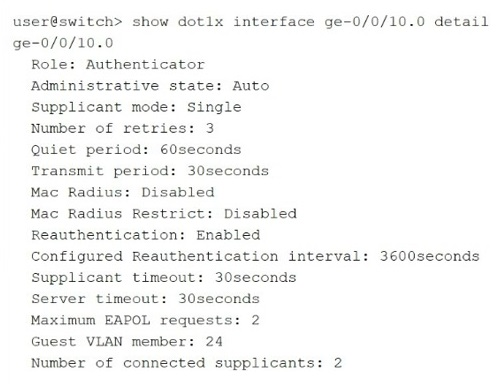
You want to limit port access to only one device at a time.
Referring to the exhibit, which configuration change will accomplish this task?
AEnable MAC RADIUS restrict.
BChange the supplicant mode to multiple.
CChange the supplicant mode to single-secure.
DChange the maximum EAPOL request to 1.
Click the Exhibit button.
Referring to the exhibit, leaf2 is elected the designated forwarder.
Which two statements are correct if server2 generates a broadcast frame? (Choose two.)
AThe broadcast frame will be forwarded to leaf1 and leaf2.
BThe broadcast frame will not be forwarded to leaf1.
COnly leaf2 will forward the broadcast frame to server1.
DOnly leaf1 will forward the broadcast frame to server1.
Click the Exhibit button.
Referring to the exhibit, which two statements are correct? (Choose two.)
AR1 will advertise the 203.0.113.0/24 route as an OSPF Type 7 LSA into Area 0.
BR5 will advertise the 203.0.113.0/24 route as an OSPF Type 5 LSA into Area 1.
CR1 will advertise the 203.0.113.0/24 route as an OSPF Type 5 LSA into Area 0.
DR5 will advertise the 203.0.113.0/24 route as an OSPF Type 7 LSA into Area 1.
Click the Exhibit button.
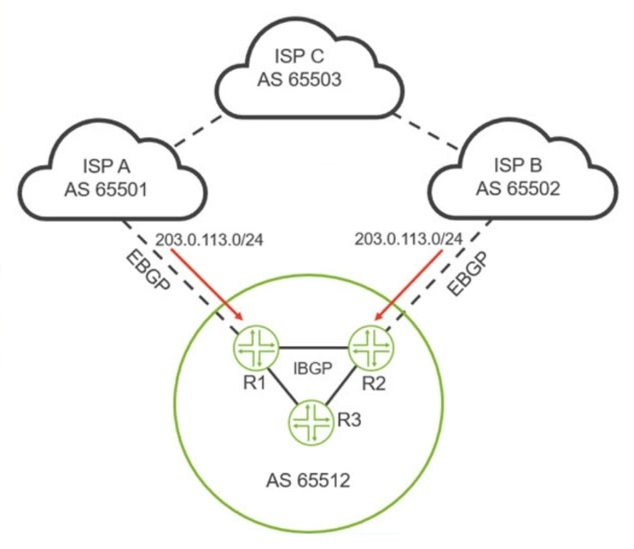
Your network receives the full Internet BGP routing table from two different ISPs. You want your local routers to use Provider A to forward all Internet traffic as long as Provider A is available.
Referring to the exhibit, which two actions would satisfy this requirement? (Choose two.)
AUse a routing policy to set the local preference attribute value higher for the routes that are learned by R1.
BUse a routing policy to set the local preference attribute value higher for the routes that are learned by R2.
CUse a routing policy to set the local preference attribute value lower for the routes that are learned by R2.
DUse a routing policy to set the local preference attribute value lower for the routes that are learned by R1.
Click the Exhibit button.
You are asked to configure VLAN load balancing on your network using MSTP.
Referring to the exhibit, which two statements are correct? (Choose two.)
ASwitch1 will be the root bridge for msti 1.
BSwitch1 will be the root bridge for msti 2.
CSwitch1 will not assume the role of root bridge for both msti1 and msti2 if Switch2 goes down.
DSwitch1 will assume the role of root bridge for both msti1 and msti2 if Switch2 goes down.
Click the Exhibit button.
Referring to the exhibit output, which statement is correct?
AThe device with an IP address of 192.168.100.2 is attached to VNI 5010.
BThe output shows the router ID of the device sending the EVPN Type 2 routes.
CThe output shows the route distinguisher of the device sending the EVPN Type 2 routes.
DIP addresses 10.1.1.1 and 10.1.2.3 are connected to the same VNI.
Which three statements about VSTP are correct? (Choose three.)
ASeparate BPDUs are flooded for each VSTP enabled VLAN.
BVSTP is incompatible with RSTP.
CVSTP is enabled by default on EX Series switches.
DVSTP supports up to 253 unique spanning tree topologies.
EA separate spanning tree instance is generated for each VLAN.
Click the Exhibit button.
Referring to the exhibit, which two statements are correct? (Choose two.)
AThe BGP configuration is for IBGP.
BThe BGP configuration includes the multipath parameter.
CThis route has two next hops available.
DThis route has a hidden next hop.
Which two statements are correct about OSPFv2 and OSPFv3? (Choose two.)
AOSPFv2 carries prefix information in LSAs.
BOSPFv3 is processed per subnet.
COSPFv2 and OSPFv3 require an Area 0.
DOSPFv3 carries flooding scope in LSAs.
Click the Exhibit button.
What is the OSPF router type shown in the exhibit for router 192.168.2.1?
Aneither an ABR nor an ASBR
Ban ASBR
Cboth an ABR and an ASBR
Dan ABR
You have configured DSCP CoS in your network and have applied BA and multifield classifiers to all interfaces.
In this scenario, which statement is correct?
AIf traffic matches both classifiers, then the multifield classifier determines into which forwarding class the traffic is assigned.
BYou must set the BA classifier to take precedence over the multifield classifier or the configuration is ignored.
CYou must set the multifield classifier to take precedence over the BA classifier or the configuration is ignored.
DIf traffic matches both classifiers, then the BA classifier determines into which forwarding class the traffic is assigned.
You are asked to configure 802.1X on an EX Series switch port that connects to a downstream switch with several devices attached. You must ensure that the first device is authenticated while all subsequent devices are permitted.
What will accomplish this request?
Asingle supplicant
BMAC RADIUS
Csingle-secure supplicant
Dmultiple supplicant
You have deployed 802.1X with server fail fallback enabled on an EX Series switch and specified the vlan-name feature for all access ports. The RADIUS server is unavailable.
Which two statements are correct in this scenario? (Choose two.)
AAll clients already authenticated will immediately be disconnected before the re-authentication timer expires.
BAll clients already authenticated will be unaffected until reauthentication is required.
CAll new clients will be granted access only if their requested VLAN matches the configuration.
DAll new clients will be placed in the referenced VLAN in the configuration and given access.
Which two statements are correct about EVPN Pure Type-5 routes? (Choose two.)
APure Type-5 routes rely on Type-7 sync routes.
BPure Type-5 routes require an overlay next hop.
CPure Type-5 routes are also known as IP-VRF-to-IP-VRF.
DPure Type-5 routes are advertised with the MAC extended community.
You are deploying IP phones in your enterprise networks. When plugged in, the IP phones must automatically be provided with their geographic location details by the EX Series switches.
In this scenario, which protocol should be used to enable this behavior?
ACDP
BLLDP-MED
CLLDP
DMP-BGP
While deploying class of service on an EX Series switch, what are two aspects of the scheduler? (Choose two.)
AIt defines interface rate-limiting.
BIt provides DiffServ code translation.
CIt identifies the priority of the queue to which it is assigned.
DIt defines a buffer size of the queue to which it is assigned.
According to IETF standards, which two statements are correct about EVPN/VXLAN deployments? (Choose two.)
AUp to 16 million EVPN broadcast domains can exist.
BUp to 16 million VXLAN broadcast domains can exist.
CIP packets within the same broadcast domain are forwarded unchanged.
DLayer 2 frames within the same broadcast domain are forwarded unchanged.
You have several switches in your network that use Cisco's PVST + protocol. You want your Juniper switches to interoperate with those devices.
In this scenario, which protocol would you use?
ARPVST+
BMSTP
CVSTP
DRSTP
Click the Exhibit button.
You configured MVRP in your Layer 2 network using the configuration shown in the exhibit. You verified that the appropriate VLANs are configured and applied on the two access switches. You are using RSTP as your loop prevention mechanism. Unfortunately, the users are not able to communicate with their corresponding server attached to the Access-2 switch.
In this scenario, what should you do to solve this problem?
AConfigure VSTP instead of RSTP as your loop-prevention mechanism.
BConfigure the access interfaces on the Access-2 switch under MVRP.
CConfigure the ge-0/0/16.0 interface on the Core-1 switch under MVRP.
DConfigure the access interfaces on the Access-1 switch under MVRP.
Click the Exhibit button.
You are deploying a new campus switching environment using various EX Series switch models. The devices attached to one of the new EX Series switches include IP phones, IoT devices, and wireless access points (APs) requiring power over Ethernet (PoE) with varying power requirements. A sample output from one of these switches is shown in the exhibit.
In this scenario, which two statements are correct? (Choose two.)
AThe switch is capable of supplying up to 60 W of power to attached PoE devices.
BPort ge-0/0/0 is enabled and has its maximum power and device class designations statically configured.
CPort ge-0/0/0 is enabled and has dynamically learned maximum power and device class designations.
DThe switch is capable of supplying up to 30 W of power to attached PoE devices.