BThese tunnels add additional overhead to the packets that traverse them.
CThese tunnels do not add any overhead to the packets that traverse them.
DThese tunnels do not offer encryption mechanisms.
You are configuring LDP in a service provider network. After enabling LDP on core interfaces, you notice that labels are being advertised for every loopback IPv4 address that is in your IGP.
Which label distribution mode is being used in this scenario?
Aconservative retention
Bordered control
Cdownstream unsolicited
Ddownstream on demand
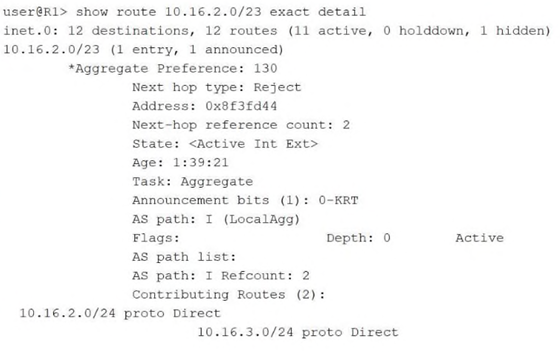
Click the Exhibit button.
Which destination IP address will be matched by the aggregate route shown in the exhibit?
Apackets destined to 10.16.1.214
Bpackets destined to 10.16.0.4
Cpackets destined to 10.16.4.183
Dpackets destined to 10.16.3.79
You are asked to configure an RSVP LSP.
Under which hierarchy is this configuration performed?
Aunder the protocols rsvp hierarchy
Bunder the protocols mpls hierarchy
Cunder the protocols ldp hierarchy
Dunder the protocols bgp hierarchy
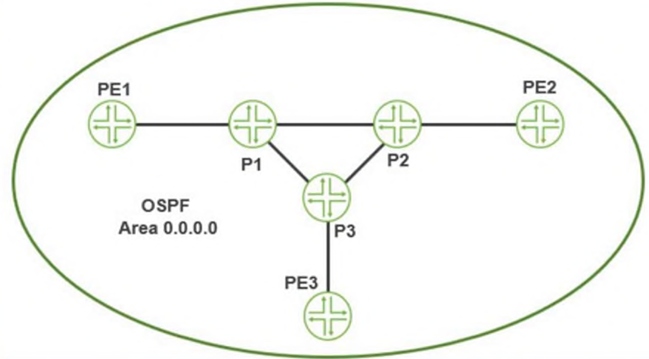
Click the Exhibit button.
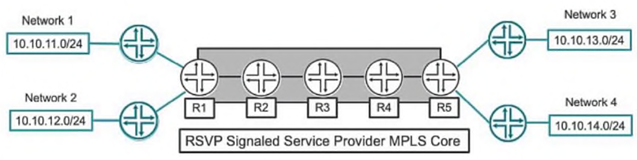
You have configured an MPLS LSP that begins on R1 and terminates on R5 using the Junos default settings.
Referring to the exhibit, which router will perform only label swap operations?
AR1
BR3
CR4
DR5
Which two protocols would be used for dynamic routing in IPv6 environments? (Choose two.)
AIS-IS
BOSPFv2
CBGP
DIGMP
A BGP router receives two routes to the same prefix. One route has a higher local preference, while the other has a shorter AS path.
In this scenario, which route would be selected?
AThe route with the lower origin code.
BThe route with the higher local preference.
CThe route with the shorter AS path.
DThe route with the lowest MED value.
During MPLS forwarding, which operation describes the act of imposing a label onto an unlabeled packet?
Alabel swap
Blabel pop
Clabel push
Dlabel rewrite
The MPLS Label Information Base (LIB) is stored in which table?
Ainet6.0
Bmpls.0
Cinet.0
Dinet.3
By default, which routing table contains a list of all ingress LSPs?
Ainet.0
Binet.1
Cinet.2
Dinet.3
You are asked to add next-hop redundancy using VRRP for an IPv6 enabled service. The configured primary router must always be active when available, and the servers connected to the network must be able to ping their gateway.
Which VRRP element is required to accomplish this requirement?
AThe accept-data parameter must be added to the VRRP configuration.
BThe preempt parameter must be added to the VRRP configuration.
CThe backup router requires the track parameter to track the primary router's interface.
DBoth routers running VRRP will require a static ARP entry to be configured for the VRRP VIP
Click the Exhibit button.
You have a network often routers that have all been configured with an identical SRGB. The exhibit shows the IS-IS configuration from a router called R10. The other nine routers do not yet have an IPv4 shortest-path SR-MPLS LSP to this router.
Which missing part of the configuration must you add on R10 to solve this problem?
AR10 must tag its internal IPv4 BGP prefixes with a BGP prefix SID
BR10 must be configured with an explicit IPv4 node SID.
CR10 must be configured with an explicit binding SID.
DR10 must be configured with explicit IPv4 adjacency SID.
You are asked to configure a new network environment that will be based on IPv6 and use OSPF.
In this scenario, which two statements correctly identify configuration task considerations? (Choose two.)
AParticipating interfaces must be configured with both IPv4 and IPv6 protocol families and addresses.
BThe router ID used must be based on a 128-bit identifier value.
CThe router ID used must be based on a 32-bit identifier value.
DParticipating interfaces are only required to be configured with the IPv6 protocol family and address.
Click the Exhibit button.
You have configured IPv4 and IPv6 in your network and all OSPF neighbors are established. You apply the configuration shown in the exhibit.
Which statement is true in this scenario?
AThere will not be a route in R1 for network 172.16.2.0/24.
BThere will only be an OSPFv3 entry in R1 for network 172.16.2.0/24.
CThere will only be an OSPFv2 entry in R1 for network 172.16.2.0/24.
DThere will be an OSPFv2 and OSPFv3 entry in R1 for network 172.16.2.0/24.
What is the default route preference for an aggregate route?
A5
B130
C150
D180
Click the Exhibit button.
A router called R6 is the ingress router for an LSP called R6_TO_R10_700m.
Referring to the exhibit, which statement is correct about the bandwidth reservation across this entire path?
AThis LSP has reserved 700 Mbps of bandwidth at priority levels 2, 1, and 0.
BThis LSP has reserved 700 Mbps of bandwidth at priority levels 2, 3, 4, 5, 6, and 7.
CThis LSP has reserved 700 Mbps of bandwidth at priority levels 1, 2, 3, 4, 5, and 7.
DThis LSP has reserved 700 Mbps of bandwidth at priority levels 2, 3, 4, 5, 6, and 7.
You are using EBGP to connect to two upstream peers in the same AS. You want to make one of the links less preferred for traffic entering your network from the peer's AS.
Which feature should you use to achieve this goal?
Aorigin code
Blocal preference
Ca route reflector
DAS-path prepending
How are routing loops prevented in internal BGP networks?
AInternal BGP routes are never readvertised to other internal BGP neighbors.
BExternal BGP routes are never readvertised to other external BGP neighbors.
CInternal BGP routes are never readvertised to other external BGP neighbors.
DExternal BGP routes are never readvertised to other internal BGP neighbors.
Click the Exhibit button.
In the exhibit, Site A is sending traffic to Site B. R1 adds MPLS label 7166 to direct the traffic to R5.
Which two criteria did R1 use to determine which label number to add to the traffic? (Choose two.)
Athe source address of the traffic
Ba label number received from R5
Ca label number advertisement received from R2
Dthe destination address of the traffic
Which feature allows Junos OS to perform recursive lookups for static route next hops?
Adiscard
Bresolve
Creject
Dnext-table
You are troubleshooting a Level 1 IS-IS router that has an adjacency with a Level 1/2 router.
Which two statements are correct in this scenario? (Choose two.)
AThe Level 1/2 router merges Level 1 and Level 2 into one complete topology.
BThe Level 1/2 router sees the Level 1 network and the Level 2 network as two separate topologies.
CThe Level 1 router will only learn the topology of the Level 1 network.
DThe Level 1 router will learn the full topology of the Level 2 network.
What happens if an IS-IS router receives a link-state PDU with a higher sequence number than the one in its database?
AIt sends a CSNP to request confirmation from the source of the link-state PDU.
BIt updates its database and floods the link-state PDU.
CIt resets the adjacency with the source of the link-state PDU.
DIt ignores the link-state PDU
In IS-IS, what would you use to control which external routes are installed in the routing table?
Aexport policy
Broute preference
Cimport policy
Dinterface metric
During OSPF neighbor establishment, which packet type is used to describe the contents of the link-state database?
ALink-State Request (LSR)
Bhello packet
CDatabase Description (DBD)
DLink-State PDU (LSP)
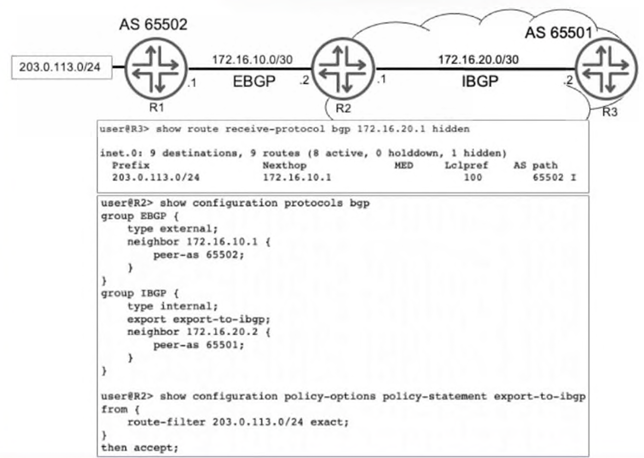
Click the Exhibit button.
Referring to the exhibit, R1 is advertising prefix 203.0.113.0/24 to R2 over EBGP. R2 is configured to advertise this prefix into IBGP. R3 receives the 203.0.113.0/24 route, however the route is hidden.
Which configuration statement do you need to add to R2 to solve this problem?
Aset policy-options policy-statement export-to-ibgp from route-filter 203.0.113.0/24 orlonger
Bset policy-options policy-statement export-to-ibgp then local-preference 50
Cset protocols bgp group EBGP export export-to-ibgp
Dset policy-options policy-statement export-to-ibgp then next-hop self