The Tasks of the Test Analyst in the Test ProcessThe Tasks of the Test Analyst in Risk-Based TestingTest Analysis and Test DesignTesting Quality CharacteristicsSoftware Defect Prevention
A system accepts two natural-number inputs, T1 and T2, representing successive temperature readings. Temperature is recorded in whole degrees Celsius. It returns temperature-change information using this logic:
IF T1 = T2, return the message “Temperature has not changed.”
IF T1 ≠ T2, return the message “Temperature has changed.”
You apply domain-based testing to verify that the preceding requirement is implemented correctly, following the SIMPLIFIED coverage technique.
Which set of test points, interpreted as temperature pairs (T1, T2), provides 100% of this coverage?
A(11, 11), (10, 11), (11, 12).
B(10, 10), (10, 11), (10, 9).
C(10, 10), (11, 11), (10,11).
D(11,11), (10, 12), (11, 9).
You are designing test cases based on this use case:
Use case: logging in to the online banking system
The user opens the banking application.
The system displays the login page.
The user enters their username and password.
The user clicks the “Login” button.
The system verifies the username and password in the database.
The system starts the multi-factor authentication (MFA) procedure.
The user undergoes MFA verification.
The system logs the user in and redirects them to the welcome screen.
Alternative flows:
3A: The user clicks the “Forgot Password” button. The system sends an e-mail containing a link to reset the password and returns to step 2.
5A: Incorrect password. The system displays the message “Incorrect password”, and, after the user closes the message window, returns to step 3.
Exceptions:
2A: The system is unavailable because of maintenance work. The system displays the message “Maintenance work in progress; try later” and the login process ends.
7A: MFA verification error. The system displays the message “MFA verification failed” and the login process ends.
The test strategy requires coverage of the main scenario, alternative flows, and exceptions for each use case. The strategy permits testing multiple alternative flows in one test case. Each exception must be tested in a separate test case, although a test case can contain alternative flows.
What is the MINIMUM number of test cases that achieves this coverage?
A3
B4
C5
D6
Which option BEST characterizes a test analyst’s involvement across different software development lifecycles?
AIn sequential models, the test analyst focuses primarily on functional testing. In iterative models, the test analyst focuses primarily on non-functional testing.
BIn sequential and incremental models, the test analyst focuses on automating regression testing. In iterative models, the test analyst focuses on manual testing.
CIn sequential models, the test analyst executes tests in the late phases of the software lifecycle. In incremental models, the test analyst executes tests in each increment.
DIn sequential models, the test analyst mainly uses experience-based test techniques. In iterative models, the test analyst mainly uses black-box test techniques.
Which activity is not carried out by a test analyst as part of product risk analysis?
AConducting requirement reviews to mitigate risks
BConducting interviews with users to identify risks
CPerforming risk impact assessment
DAssisting in the categorization of identified risks
QuestionQ6
Test Analysis and Test Design
0
Community Discussion
No comments yet. Be the first to start the discussion!
QuestionQ7
The Tasks of the Test Analyst in Risk-Based Testing
QuestionQ8
Test Analysis and Test Design
QuestionQ9
Testing Quality Characteristics
QuestionQ10
Test Analysis and Test Design
QuestionQ11
Test Analysis and Test Design
QuestionQ12
The Tasks of the Test Analyst in the Test Process
QuestionQ13
Test Analysis and Test Design
QuestionQ14
Test Analysis and Test Design
QuestionQ15
Test Analysis and Test Design
QuestionQ16
Test Analysis and Test Design
QuestionQ17
Software Defect Prevention
Save question
0
Community Discussion
No comments yet. Be the first to start the discussion!
Save question
0
Community Discussion
No comments yet. Be the first to start the discussion!
Save question
0
Community Discussion
No comments yet. Be the first to start the discussion!
Save question
0
Community Discussion
No comments yet. Be the first to start the discussion!
Save question
0
Community Discussion
No comments yet. Be the first to start the discussion!
Save question
0
Community Discussion
No comments yet. Be the first to start the discussion!
Save question
0
Community Discussion
No comments yet. Be the first to start the discussion!
Ad
Want a break from the ads?
Go ad-free and unlock Learn Mode, Exam Mode, AstroTutor AI and every premium tool — everything you need to walk in prepared, and confident.
No comments yet. Be the first to start the discussion!
Save question
0
Community Discussion
No comments yet. Be the first to start the discussion!
Save question
0
Community Discussion
No comments yet. Be the first to start the discussion!
Save question
0
Community Discussion
No comments yet. Be the first to start the discussion!
Your regression test suite contains five test cases, TC1–TC5. They cover use-case scenarios UC1–UC10 as follows:
TC1 covers UC1, UC2, UC3, UC4, UC5, UC6, UC7, UC8
TC2 covers UC7, UC8
TC3 covers UC2, UC4, UC6, UC7
TC4 covers UC10
TC5 covers UC5, UC8, UC9
The system has three components: C1, C2, and C3.
C1 implements UC1, UC2, UC3, and UC4.
C2 implements UC5, UC6, and UC7.
C3 implements UC8, UC9, and UC10.
The latest project iteration refactored component C3. Your organization follows a scenario-coverage-based regression test-selection strategy.
Because of time constraints, only two regression tests can be run. Which TWO test cases should be executed?
Choose two
ATC1
BTC2
CTC3
DTC4
ETC5
What is one example of a risk related to automated test design?
AOmission of important test conditions from the software model
BHigh cost of test execution due to software changes
CDifficulty in analyzing the results of the automated test execution
DReduction of repetitive work involving manual test specification
Which limitation of unguided random testing can be avoided by using guided random testing?
ANeglecting the semantics of generated test input values
BDependency on an automated test oracle
CRandom outputs leading to inconsistent test results
DGeneration of test cases with the same input values
As a test analyst, you have been asked to perform a role-based usability review of the electronic banking system’s user interface. The interface enables the user to select a language from English, Spanish, or Italian. The system is protected by a multi-factor authentication mechanism. After logging in, the user can manage their loans.
During the review, you assume the role described by the following persona:
Name: Maria Rossi
Age: 64
Occupation: Retired Italian language teacher
Knowledge of technology: Basic; she is afraid of technology
Hardware: Windows laptop, Android phone
Place of residence: Rome, Italy
Language skills: Italian (native), Spanish (basic)
What could MOST likely be reported during this review?
ADifficulty in understanding the rules for calculating interest on loans
BDifficulty in understanding the interface in English
CDifficulty in using the multi-factor authentication mechanism
DDifficulty in running the app on an iOS phone
You are evaluating an image-recognition system based on a deep neural network. The system receives as input a 1000×1000-pixel image of a geometric figure—a triangle, square, or circle. The figure has one color and appears on a solid background of a different color. The figure may be any size and may be positioned anywhere in the image. The system classifies the output figure as a triangle, square, or circle. If it receives an image that does not satisfy the preceding requirements, it returns “unrecognized shape.”
You want to test the correctness of this system using metamorphic testing.
Which of the following is NOT a valid metamorphic relation for this scenario?
AChanging the position of the figure (but so that it is still visible in its entirety) does not change the system’s answer
BRotating the image 90 degrees to the right or left does not change the system’s response
CChanging the figure's color does not change the system’s response
DScaling down the figure does not change the system’s response
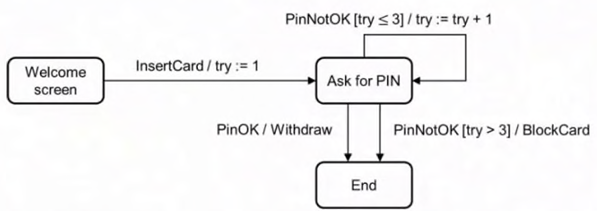
Below is a state transition diagram modelling the behaviour of the component that verifies whether the PIN entered by the user is correct. The system starts operating in the “Welcome screen” state and finishes in the “End” state.
The system should permit three attempts to enter the PIN. If the user enters the correct PIN on any of these attempts, the system performs a withdrawal and ends the operation. If the third attempt is incorrect, the system blocks the card and ends the operation. As a test analyst, you review this diagram for potential defects that could be introduced into the system created from this model.
What should be the conclusion of your analysis?
AThe system implemented according to this specification will work properly
BThe system allows the PIN to be entered incorrectly an arbitrary number of times
CThe system blocks the card after entering the correct PIN
DThe system does not block the card after the PIN is entered incorrectly three times
BeRich is preparing to launch a mobile application to manage personal finances. The app is expected eventually to attract a broad range of users, from young people through adults to retirees. It provides various functions, including budgeting, expense analysis, saving, and financial advice. The project team includes specialists from different departments: marketing, product development, testing, UX, and system architecture. To ensure consistent performance and positive reception of the application, the team will review the functional documentation before entering the intensive implementation phase.
Each department views the app through the lens of its own goals and expertise. For marketing, it is essential that the application offers unique market-differentiating features that are intuitive for users. The system architecture team concentrates on scalability, security, and protection of user data. Testers, on the other hand, focus on making sure that every function is easy to test and on anticipating scenarios that could create user problems. In contrast, UX specialists focus on the application’s accessibility for a wide range of users.
Which type of review applied to the functional documentation would be the BEST solution in this scenario?
ARole-based review
BChecklist-based review
CPerspective-based reading
DScenario-based review
A route-finding application takes a starting point, an ending point, and a map containing information about one-way streets as inputs. It returns the length, in meters, of the shortest possible route.
You want to verify this system’s correctness with metamorphic testing using these two metamorphic relations:
MR1: For a route from point A to point B, changing one or more one-way streets to two-way streets cannot increase the route length.
MR2: For a map and points A, B, and C, the route length from A to C cannot exceed the combined lengths of the routes from A to B and from B to C.
You intend to test a computer game across several configurations. A configuration includes:
operating system (2 possible values: Windows 10, Windows 11)
browser (3 possible values: Edge, Chrome, Firefox)
RAM type (3 possible values: 16 GB, 32 GB, 64 GB)
You apply pairwise testing. So far, you have designed these test cases:
TC1: Windows 10, Edge, 64 GB -
TC2: Windows 11, Chrome, 32 GB -
TC3: Windows 10, Firefox, 64 GB -
TC4: Windows 10, Firefox, 16 GB -
TC5: Windows 11, Chrome, 64 GB -
TC6: Windows 11, Edge, 32 GB -
What is the MINIMUM number of test cases that must be added to the existing six test cases so that the resulting test set attains 100% pairwise coverage?
A3
B4
C7
D12
Your organization is implementing a food-ordering application that is intended to have an intuitive user interface (easy navigation and fast search) and to offer functions such as:
personalization of the order (the ability to modify ingredients and add comments for the restaurant)
verification of order correctness before it is sent
real-time order tracking
viewing order history
Management has decided to test the requirements listed above with a checklist and has asked you to prepare one. Consider the following four checklists.
Checklist 1 -
[ ] Does the system reject an order with an incorrect zip code?
[ ] Does the system reject an order with an unfilled mandatory field?
Checklist 2 -
The interface allows the user to easily navigate the application (YES / NO / PARTIALLY)
The search function allows the user to quickly search for restaurants (YES / NO / PARTIALLY)
Checklist 3 -
[ ] Is the time from order placement to order confirmation less than 10s?
[ ] Is the user interface free of grammatical errors?
Checklist 4 -
The application works properly on the Android operating system (YES / NO)
The application works properly on the iOS operating system (YES / NO)
Which of the following is an example of a read-do checklist that is useful for testing the application described in the scenario?
AChecklist 1
BChecklist 2
CChecklist 3
DChecklist 4
Which of the following is NOT an example of a test-data requirement for an online food-ordering application?
ACustomer information should include realistic customer profiles with various names, addresses, phone numbers, and email address formats
BOrder details should be described in an XML file, the format and structure of which comply with the rules described in section 6.5 of this document
CThe geographical coordinates representing the customer’s residence should be given to 4 decimal places
DThe application should be tested on emulators of Apple iPhone 15, Samsung Galaxy S24, Apple iPhone 15 Pro, and Samsung Galaxy S24 Ultra
Which of the following is not an example of a test analyst’s contribution to defect prevention?
AParticipating in risk analysis meetings
BParticipating, as a reviewer in requirements reviews
CIdentifying possible improvements during retrospective meetings
Community Discussion