About the Exam

This proctored written exam is the exam component for the HPE Aruba Networking Certified Expert - Campus Access Switching certification. It covers advanced campus access switching topics, including design and implementation of complex HPE Aruba Networking wired and wireless networking solutions, security, connectivity, performance optimization, and troubleshooting. Passing demonstrates that a candidate can design and implement expert-level HPE Aruba Networking campus access solutions.

Exam Topics

  • Network Stack4%
  • Connectivity9%
  • Network Resiliency and virtualization8%
  • Switching19%
  • WLAN9%
  • Routing16%
  • Security10%
  • Authentication/Authorization9%
  • Troubleshooting10%
  • Performance Optimization6%

How to Use This Practice Exam

  1. Browse — Read each question, select your answer, and reveal the explanation.
  2. Exam Mode — Simulate real exam conditions with a timed session and score report.
  3. Learn Mode — Spaced repetition schedules questions you struggle with for long-term retention.

Download the Full Exam PDF

Get every question and answer in a clean, printable PDF built for offline study. Purchase once, keep permanent access, and re-download the latest version anytime.

Last updated January 4, 2026 at 9:42 PM

Topic filter
Retired questions
Question sort
Questions per page

QuestionQ1

Routing

An OSPF router has learned routes to an external network through both E1 and E2 advertisements, with both routes having the same path cost.

Which path will the router prefer?

Explanation

OSPF gives an external Type 1 (E1) route preference over an external Type 2 (E2) route for the same destination. An E1 metric incorporates the internal cost to reach the advertising ASBR, whereas an E2 metric is primarily the external metric.

Community Discussion

No comments yet. Be the first to start the discussion!

QuestionQ2

Troubleshooting

You recently configured a switch for 802.1X authentication using HPE Aruba Networking ClearPass. A security administrator observes events in ClearPass Event Viewer with this description:

RADIUS authentication attempt from unknown NAD (10.10.1.10:1812)

Which command should be used to identify the configuration issue?

Explanation

ClearPass recognizes a RADIUS NAD by the source IP address of the RADIUS request. The RADIUS-specific source-interface configuration determines that address; if it is 10.10.1.10 and ClearPass has no matching NAD definition, ClearPass reports an unknown NAD. show ip source-interface radius displays the configured source interface/IP for RADIUS traffic.

Learn more

Community Discussion

No comments yet. Be the first to start the discussion!

QuestionQ3

Switching

A client wants to use the HPE Aruba Networking Switch MultiEdit Software function in HPE Aruba Networking Central.

Which option is available?

Explanation

MultiEdit’s Express Config capability can apply predefined configuration settings, such as NAE scripts, to a single switch or multiple selected AOS-CX switches.

Learn more

Community Discussion

No comments yet. Be the first to start the discussion!

QuestionQ4

Authentication/Authorization

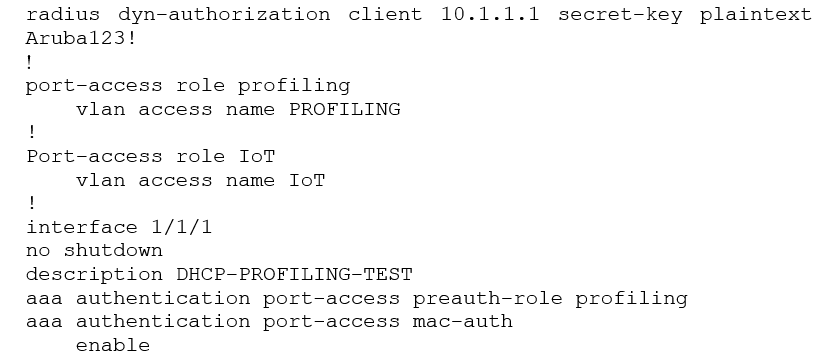
Based on the configuration shown below, identify the proper event sequence for wired DHCP profiling of IoT devices using HPE Aruba Networking ClearPass.

Question Image

Drag & Drop
Explanation

A profiling role provides limited initial access while DHCP fingerprint information populates the endpoint record. ClearPass then uses RADIUS CoA to cause a second authorization, which can return the final IOT role and corresponding VLAN access.

Learn more

Community Discussion

No comments yet. Be the first to start the discussion!

QuestionQ5

Performance Optimization

Refer to the exhibit.

Question Image

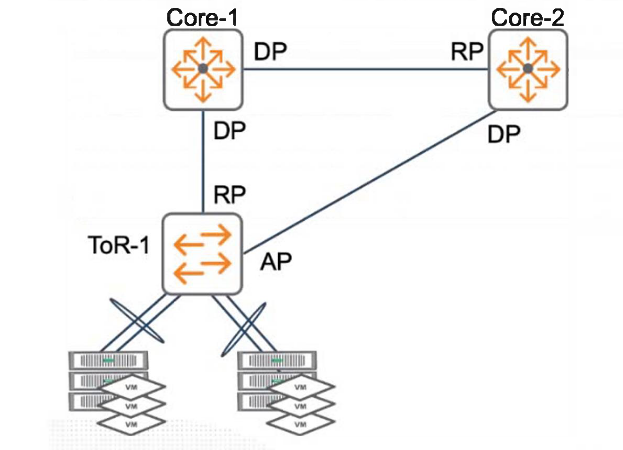
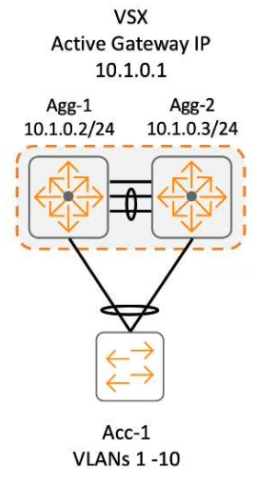
Acme Corp has VM workloads running downstream from ToR-1 and has observed performance degradation. They suspect that the ToR-1 uplinks are periodically overutilized. A partner has recommended migrating the legacy 1U Core-1 and Core-2 switches to the CX 6400 series.

Which aspects of this platform would address the customer’s problem while following HPE Aruba Networking best practices?
Choose two
Explanation

A CX 6400 VSX pair supports multi-chassis LAG, allowing the two core switches to appear as one Layer 2 peer to the downstream 802.3ad/LACP device. This enables active-active forwarding over the ToR uplinks. CX 6400 chassis port density can also allow direct attachment of VM hypervisors to the core, eliminating the constrained ToR uplink path. VSX—not VSF/backplane stacking—is the appropriate high-availability architecture for CX 6400 core deployments.

Learn more

Community Discussion

No comments yet. Be the first to start the discussion!
Know a question that should be here? Contribute to this exam
Back home