About the Exam

This exam is part of the F5 Certified Administrator, BIG-IP certification and is aimed at candidates in operational roles who administer BIG-IP systems. It tests knowledge, skills, and abilities for BIG-IP Administration for Data Plane Configuration, including day-to-day operations and basic deployment, management, security, and support after BIG-IP has been installed, configured, and implemented. Passing demonstrates competence in administering BIG-IP in application environments and an understanding of both data plane and control plane administration.

Exam Topics

  • Apply procedural concepts required to modify and manage virtual servers100%

How to Use This Practice Exam

  1. Browse — Read each question, select your answer, and reveal the explanation.
  2. Exam Mode — Simulate real exam conditions with a timed session and score report.
  3. Learn Mode — Spaced repetition schedules questions you struggle with for long-term retention.

Download the Full Exam PDF

Get every question and answer in a clean, printable PDF built for offline study. Purchase once, keep permanent access, and re-download the latest version anytime.

Last updated March 16, 2026 at 6:40 AM

Topic filter
Retired questions
Question sort
Questions per page

QuestionQ1

Apply procedural concepts required to modify and manage virtual servers

A BIG-IP Administrator must load balance a pool of web servers. The load-balancing decision must consider the number of active connections on each pool member.

Which load-balancing method satisfies this requirement?

Explanation

BIG-IP Least Connections (member) directs each new connection to the pool member with the fewest active connections, so its selection directly accounts for active connection load at the pool-member level.

Learn more

Community Discussion

No comments yet. Be the first to start the discussion!

QuestionQ2

Apply procedural concepts required to modify and manage virtual servers

Which persistence method would be best for F5 to load balance traffic from clients that use a single source IP (NAT) across multiple pool members with even distribution for an HTTPS web application?

Explanation

Cookie persistence uses an HTTP cookie stored by each client to return that client to its previously selected pool member. It avoids treating every NATed client as the same source address, allowing initial client sessions to be distributed among pool members while retaining session affinity. Source-address affinity would map the shared NAT IP address to one member.

Learn more

Community Discussion

No comments yet. Be the first to start the discussion!

QuestionQ3

Apply procedural concepts required to modify and manage virtual servers

How does the BIG-IP system distribute traffic according to the configuration below?

pool my_pool \{  
  
Ib_mode fastest -  
min active members 2  
member 10.12.10.7:80 priority 3  
member 10.12.10.8:80 priority 3  
member 10.12.10.9:80 priority 3  
member 10.12.10.4:80 priority 2  
member 10.12.10.5:80 priority 2  
member 10.12.10.6:80 priority 2  
member 10.12.10.1:80 priority 1  
member 10.12.10.2:80 priority 1  
member 10.12.10.3:80 priority 1  
\}  
Choose two
Explanation

With priority-group activation set to a minimum of two active members, BIG-IP initially distributes connections to priority group 3. If priority groups 3 and 2 each have fewer than two available members, BIG-IP directs traffic to priority group 1. A priority-3 group with one failed member still has two active members, so traffic remains confined to that group.

Learn more

Community Discussion

No comments yet. Be the first to start the discussion!

QuestionQ4

Apply procedural concepts required to modify and manage virtual servers

All pool members are online, and every other virtual-server setting remains at its default value.

What could change the load-balancing behavior?

Explanation

A persistence profile maintains affinity between a client and a selected pool member. That affinity is honored for later traffic, so normal load-balancing selection may no longer distribute each new connection independently across the available members.

Learn more

Community Discussion

No comments yet. Be the first to start the discussion!

QuestionQ5

Apply procedural concepts required to modify and manage virtual servers

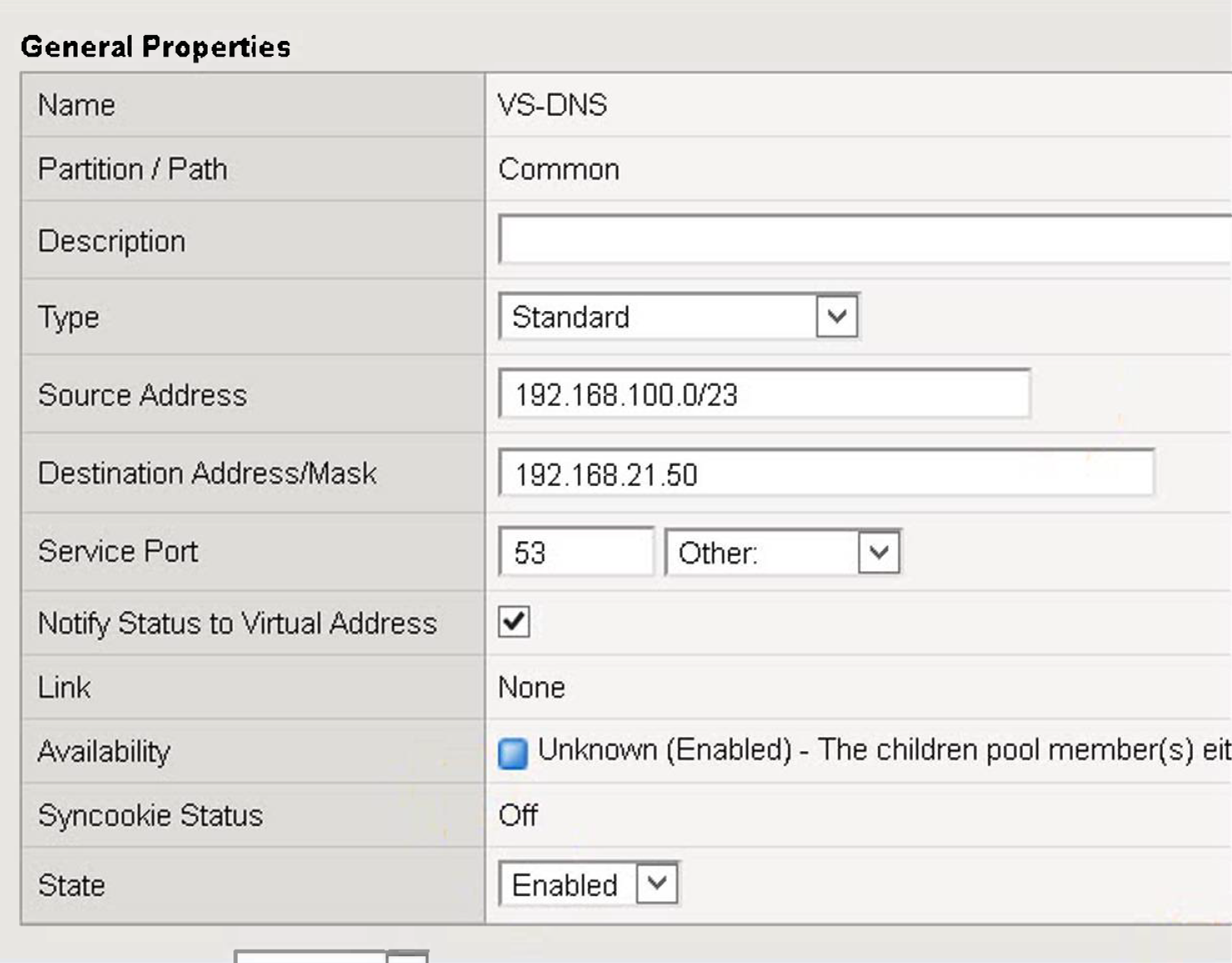
Refer to the exhibits above.

Question Image

Question Image

DNS queries from two internal DNS servers are load-balanced to external DNS servers through a Virtual Server on a BIG-IP device. The DNS queries originate from 192.168.101.100 and 192.168.101.200 and are directed to 192.168.21.50.

All DNS queries intended for the external DNS servers fail. Which Virtual Server property should the BIG-IP Administrator change to fix this issue?

Explanation

The virtual server must use UDP because conventional DNS queries are sent on UDP port 53. A TCP virtual server does not match those UDP flows. The configured /23 source network already includes both 192.168.101.100 and 192.168.101.200.

Learn more

Community Discussion

No comments yet. Be the first to start the discussion!

That's the end of the preview

It's free

100% of the questions are free for all users.
No strings attached.
Topics covered
Apply procedural concepts required to modify and manage virtual servers
Know a question that should be here? Contribute to this exam
Back home