QuestionQ20

Routing Policy and Manipulation

Question Image

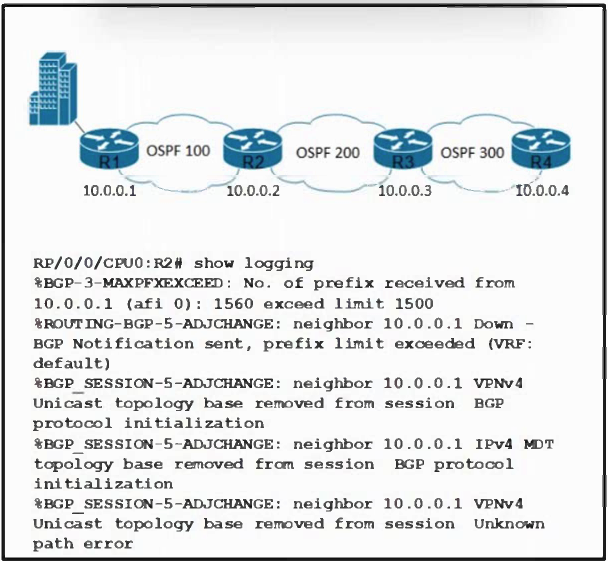
Refer to the exhibit. After maintenance activities to bring up BGP neighbors for a new data center attached to R1, L3VPN customers connected to OSPF domain 100 have lost connectivity to services located in OSPF domain 200 and OSPF domain 300. However, Unified MPLS services within OSPF domain 100 continue to be reachable. Which action must the network engineer take to resolve the outage?

  • A Activate BGP neighbors between the new data center and R2 and R3.
  • B Reset the BGP session between R1 and R2.
  • C Raise the maximum prefix limit on R2 to 1560 or more
  • D Establish new MPLS LSPs from R1 to R2. R3, and R4
Explanation

The log entries show that R2's BGP session to neighbor 10.0.0.1 (R1) was torn down because the number of received VPNv4 prefixes (1560) exceeded the configured maximum-prefix limit (1500). This is a standard BGP maximum-prefix protection mechanism, and once triggered it drops the peering (and any associated VPNv4/MDT topologies) until the condition is manually cleared and, if the true prefix count is legitimately higher, the limit is raised. Because R2 functions as the ABR/route-reflector point between OSPF 100 and the rest of the Unified MPLS core, losing that VPNv4 session prevents propagation of L3VPN routes between OSPF 100 and OSPF 200/300, while OSPF 100's own internal Unified MPLS LSPs/services remain unaffected since they do not depend on that BGP session. The fix is to raise the maximum-prefix limit on R2 for that neighbor to at least 1560 (or higher) so the session can stay up and carry the additional prefixes introduced by the new data center.

Learn more

Community Discussion

No comments yet. Be the first to start the discussion!