QuestionQ296

Infrastructure Services

Question Image

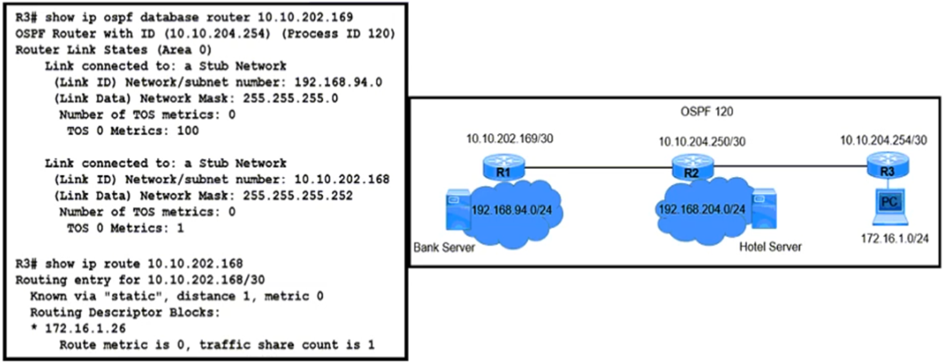
Refer to the exhibit. A network engineer discovers that PC1 can access the hotel website to make a booking but cannot complete payment. Which action resolves the issue?

  • A Increase the AD to 200 of static route 192.168.94.0 on R3.
  • B Configure a reverse route on R1 for PC1 172.16.1.0/24.
  • C Decrease the AD to 5 of OSPF route 192.168.94.0 on R1.
  • D Allow stub network 10.10.202.168/30 on router R3 OSPF.
Explanation

Booking traffic (to the Hotel server behind R2) works, but payment traffic to the Bank server 192.168.94.0/24 behind R1 fails, so the problem is specific to reaching R1's networks from R3. R1's router LSA correctly advertises 192.168.94.0/24 into OSPF, so R3 should learn it via OSPF (AD 110). However the 'show ip route' output reveals R3 is using a static route (AD 1) whose next hop 172.16.1.26 points back into PC1's own LAN - a black hole - and that lower-AD static overrides the good OSPF path. Raising the administrative distance of the offending static route toward the bank network to 200 (choice A) lets the OSPF route win and restores the correct path, fixing payment. Options C (OSPF AD is already better than a floating static once the static is raised) and D/B do not address the static-vs-OSPF preference that the exhibit highlights. Community discussion is split between A and B; A best matches the static-override evidence shown.

Learn more

Community Discussion

No comments yet. Be the first to start the discussion!