QuestionQ58
VerifiedProtect and DefendA customer has an HPE Aruba Networking ClearPass cluster. The customer has AOS-CX switches that use 802.1X authentication with HPE Aruba Networking ClearPass Policy Manager (CPPM).
The switches use local port-access policies.
The customer wants to begin tunneling wired clients that pass user authentication only to an HPE Aruba Networking gateway cluster. The gateway cluster must assign these clients the eth-internet role. The gateway must also assign the clients to VLAN 20.
The planned enforcement policy and profiles are shown below:
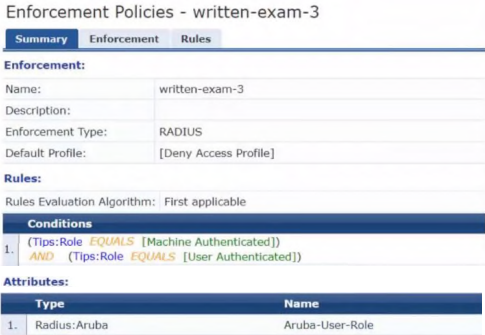
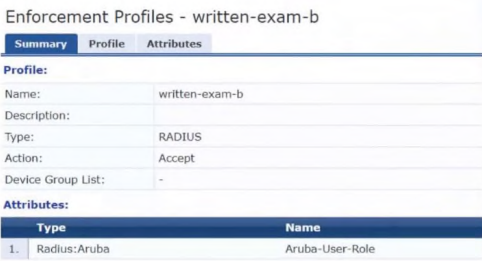
The gateway cluster contains two gateways with these IP addresses:
-
Gateway 1
- VLAN 4085 (system IP) = 10.20.4.21
- VLAN 20 (users) = 10.20.20.1
- VLAN 4094 (WAN) = 198.51.100.14
-
Gateway 2
- VLAN 4085 (system IP) = 10.20.4.22
- VLAN 20 (users) = 10.20.20.2
- VLAN 4094 (WAN) = 198.51.100.12
-
VRRP on VLAN 20 = 10.20.20.254
The customer requires high availability for tunnels between the switches and the gateway cluster. If one gateway fails, the other gateway must take over its tunnels. The switch must also be able to discover the gateway cluster whether either gateway is in the cluster.
Refer to the scenario.
What is one change that should be made to the solution?
Community Discussion